
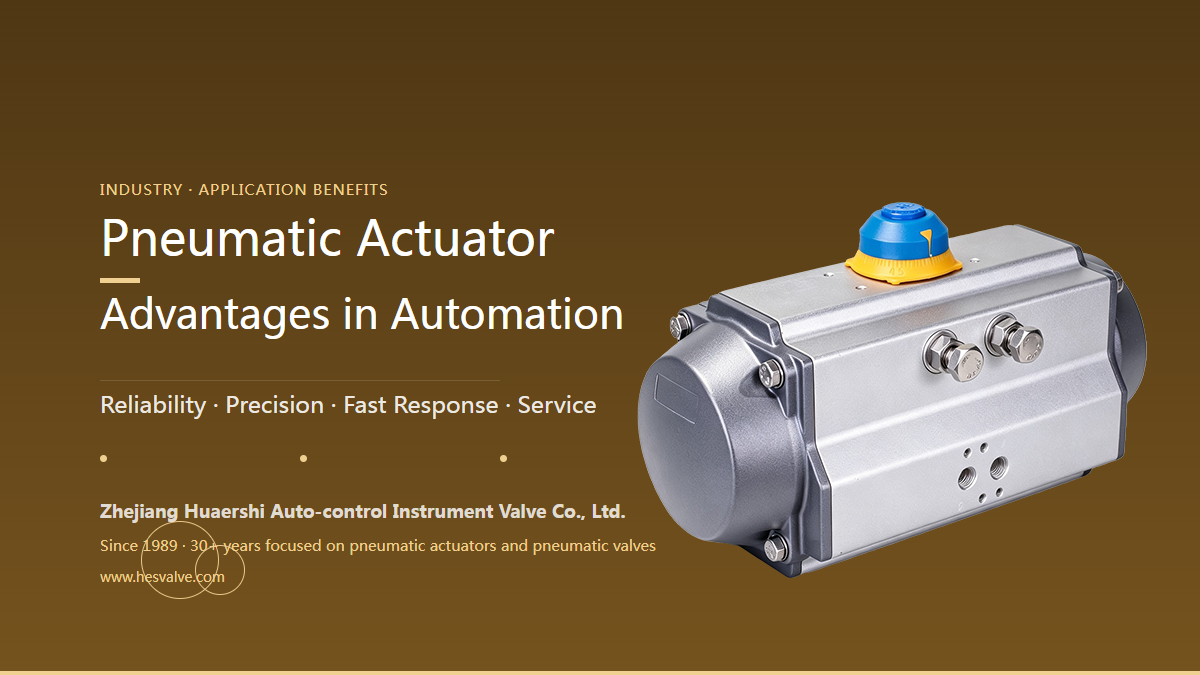
Pneumatic actuators are generally used in combination with valves, and because of their features and advantages they hold an important position in the field of industrial automation. They are both the executor of "opening and closing" and "regulating" on the pipeline, and a link that determines whether an automation solution can truly be implemented. This article starts from the division of labor with cylinders, explains the advantages clearly, and also sets out the limits and points to note.
1. First Clarify Its Position in the Automation System
-
Used in combination with valves: converts the control signal into the opening/closing or regulating action of the valve, ultimately reaching the process
-
Control upstream, valve downstream: on one side are the signals from solenoid valves, positioners, DCS/PLC; on the other side is the valve body
-
Its value is measured by three things: whether it can act reliably under harsh conditions, whether it can position precisely, and whether maintenance is trouble-free
In other words, the controller is responsible for "judging" and the actuator for "acting". However good the control strategy, in the end it must be implemented through the actuator onto the valve — which is also why its position in the automation system is stable and not easily replaced.
2. Advantage One: Reliable Operation Under Harsh Conditions, Simple Operation and Easy Maintenance
Compared with cylinders, pneumatic actuators can work reliably under harsh conditions, are simple to operate and can basically achieve maintenance-free operation. This is especially important in sites such as chemicals, metallurgy, power and water treatment where there is a lot of dust, humidity, strong vibration and high temperature — that the equipment can run continuously and stably is more real than any parameter promotion.
On these occasions, the actuator often runs non-stop all year round: the medium is corrosive, the ambient temperature varies greatly, and the air supply conditions are not ideal either. Its simple structure, direct action and independence from electric drive mean it naturally has fewer failure points, and on-site personnel do not need to stop frequently for inspection.
One reminder: the so-called "maintenance-free" is relative to the simpler cylinder; air supply quality and seals must still be checked periodically, and only then does "maintenance-free" hold up.
3. Advantage Two: The Division of Labor with Cylinders — Cylinders for Reciprocating Handling, Actuators for Multi-Position Control
Cylinders are good at reciprocating linear motion, especially for the linear handling of workpieces in industrial automation; throttle valves installed on both sides of the cylinder allow simple and stable speed control, which is also a major advantage of cylinder drive. Therefore, for users without multi-point positioning requirements, the vast majority will consider using cylinders for convenience.
Pneumatic actuators, by contrast, face a different type of need — high precision and multiple positions. The two are not a matter of one replacing the other, but of a different division of labor: where continuous position control is needed and the valve must work together to complete a process action, use an actuator; where only linear pushing and pulling is done and there is no requirement on the number of positioning points, a cylinder is more economical.
Remember these two sentences, and selection will not repeatedly agonize over "cylinder or actuator": look at the number of positioning points and the control accuracy, not at which is more common.
4. Advantage Three: Fast Response Time, with Speed, Position and Torque Accurately Controlled
At present, the application of pneumatic actuators in industry is mainly for high precision and multiple positions. Their advantage is a fast response time, and accurate control of speed, position and torque through a feedback system.
This is exactly why they are irreplaceable in automated production lines, regulating loops and safety interlocks: they must not only "move", but "move accurately and controllably".
In terms of configuration, "controllable" relies on a set of feedback: a limit switch feeds back the open/close position signal, a valve positioner receives a 4–20mA signal and outputs air pressure proportionally to achieve continuous control of the opening, and position feedback sends the actual opening back to the control system, forming a closed loop. The actuator body is only one link in this; whether the accessories are in place directly determines how far the accuracy can go.
5. Three Limits to Note
-
Linear motion requires a transmission mechanism: when linear motion is required, transmission must be carried out through mechanical devices such as gears, which brings additional mechanical loss and installation requirements
-
Requirements on the working environment and personnel: there are relatively high requirements on the working environment and on the professional knowledge of operation and maintenance personnel; selection should assess the on-site conditions together with the maintenance capability
-
The air supply is a prerequisite: the dryness, cleanliness and pressure stability of the compressed air determine actual performance. Doing the three things — drying, filtering and pressure reduction — solidly allows the actuator to truly maintain a "maintenance-free" state over the long term; if air treatment is inadequate, the advantages are discounted
6. Summary and Selection Advice
In one sentence: reliable under harsh conditions, simple operation and maintenance, fast and controllable response are the three major advantages of pneumatic actuators in industrial automation; high precision and multiple positions are their main battlefield, while reciprocating linear handling is better left to cylinders.
When selecting, judge in order:
-
Whether continuous positioning and precise control are needed — if so, choose an actuator; otherwise a cylinder may be considered
-
Whether the on-site environment and explosion-proof requirements are met
-
Whether the air supply conditions and supporting accessories (solenoid valve, positioner, limit switch) are in place
-
Whether the maintenance capability and spare parts supply can keep up
Conclusion
The value of a pneumatic actuator lies not in being "more advanced" than other solutions, but in its reliability under harsh conditions, its controllability in multi-position scenarios, and its relatively trouble-free maintenance. With both the advantages and the limits laid out clearly, selection naturally shows where it should be used. For pneumatic actuator selection and configuration advice, please contact our service team.
Zhejiang Huaershi Auto-control Instrument Valve Co., Ltd.
Since 1989 · 30+ years focused on pneumatic actuators and pneumatic valves
Website: