
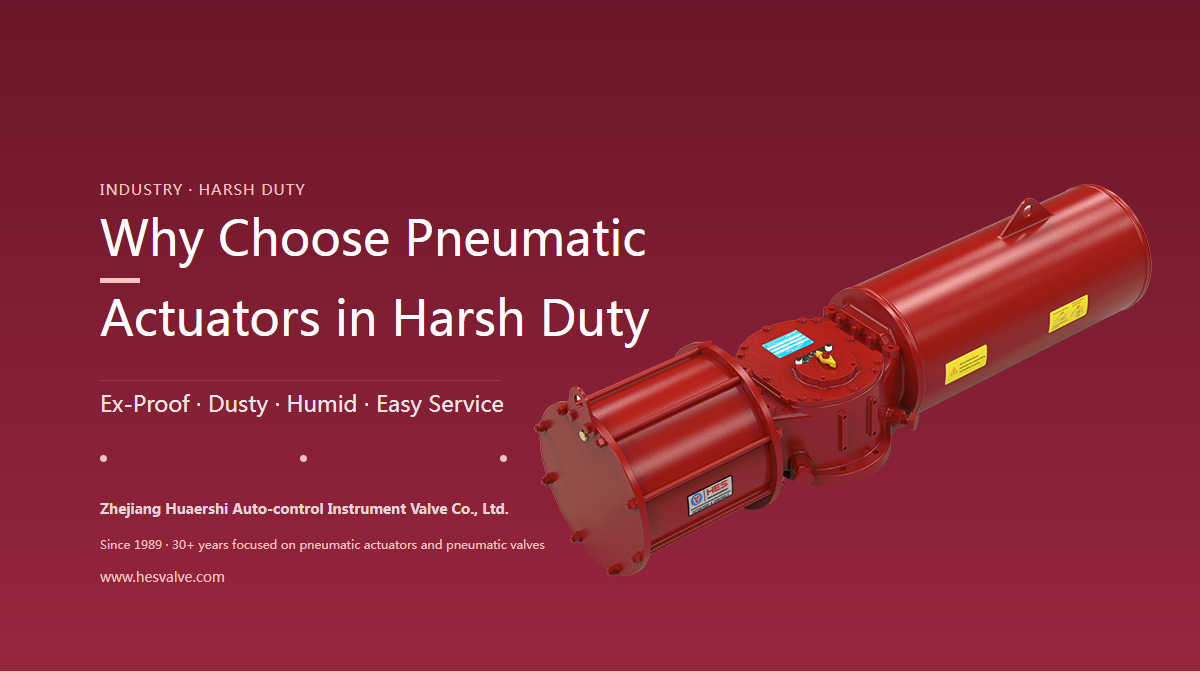
Many people compare pneumatic actuators with electric actuators, but in fact these two types of actuator are not mutually exclusive — each has its own benefits. The real question is not "which is better", but which is more suitable and more trouble-free under specific operating conditions — especially in harsh environments such as explosion-proof, dusty and humid ones. This article starts from common misunderstandings, explains clearly the division of labor between the two, and then gives several aspects to consider during selection.
1. First Clear Up a Common Misunderstanding
The most common misunderstanding of pneumatic actuators is the belief that their execution effect is relatively poor and that they cannot position precisely, so that whenever high operating accuracy is required, an electric actuator is chosen directly.
The premise of this judgment is too one-sided. The choice of an actuator depends on the operating conditions, not on positioning accuracy alone — in many harsh environments, whether it can act stably over the long term is more critical than the accuracy figure. Only by understanding this layer does the following discussion make sense.
2. What Counts as a "Harsh Environment": Three Typical Scenarios
-
Occasions with explosion-proof requirements: areas such as petrochemicals, gas and coating, where the electrical equipment itself may be a source of risk
-
Working environments with a lot of dust: sites such as cement, metallurgy and grain processing, where dust is unfriendly to both the heat dissipation of electrical components and the moving parts
-
Relatively humid working environments: water treatment, washing and screening, coastal or outdoor installations, where humidity and corrosion continuously test the equipment
These three types of scenario share a common point: environmental factors themselves are continuously consuming the reliability of the equipment. Seals age faster, moving parts accumulate dust or rust, and electrical components face poor heat dissipation and insulation risks — once equipment stops because of the environment, the loss is often far greater than the small price difference saved at purchase.
3. Under Harsh Environments, the Three Strengths of Pneumatic Actuators
If the equipment is used in a harsh environment, it is still better to adopt a pneumatic actuator, mainly for three reasons:
-
Relatively simple structure: few parts, direct action, naturally fewer failure points, and not prone to breaking down due to dust accumulation or moisture
-
Relatively convenient and simple maintenance: on-site personnel can handle it without complex professional tools, downtime is short, and spare parts cost less
-
Can achieve simple, fast, linear cyclic motion: it does not fatigue easily under repeated opening and closing or frequent action, and acts crisply and cleanly
In addition, because it is driven by compressed air and does not depend on electricity, its adaptability in the above environments is noticeably better. For the user, this characteristic of "unassuming but stable over the long term" is precisely the quality most needed in harsh conditions.
4. Pneumatic and Electric Are Not an Either-Or, but Each Has Its Role
-
Occasions better suited to electric actuators: where high-precision continuous positioning and frequent regulation are needed, where on-site power and signal conditions are good, and the environment is relatively mild
-
Occasions better suited to pneumatic actuators: where there are explosion-proof requirements, dusty, humid or corrosive environments, and mainly on/off shut-off with a need for fast action
-
The two are also often used together: in the same installation, key regulating loops use electric, while shut-off and safety interlocks use pneumatic, each playing to its strengths
The recommended order of judgment is: look at the environment first, then at the control requirements. If the environment is not up to it, however high the accuracy figure is, it will not last.
A common combination example: on a pipeline with explosion-proof requirements, a loop that needs continuous flow regulation uses an electric control valve, while emergency shut-off and safety interlock use a pneumatic actuator with a ball valve or butterfly valve. This satisfies both the accuracy requirement and holds the safety bottom line.
5. Several Aspects to Consider in Selection
So when choosing an actuator, aspects on all sides must be considered, not just a single factor:
-
Operating environment: explosion-proof rating, dust, humidity, temperature and corrosiveness
-
Action requirements: on/off shut-off or continuous regulation, and roughly how frequent the action is
-
Output torque: whether a margin is reserved, and whether it can overcome the resistance of the valve under actual conditions
-
Air supply conditions: whether the pressure is stable and the air dry and clean (this is the prerequisite for the pneumatic solution to deliver its advantages)
-
Supporting accessories: whether the solenoid valve, positioner, limit switch and filter regulator are complete
-
Maintenance capability: whether on-site inspection and spare part replacement can be done conveniently
6. Summary and Recommendations
In one sentence: pneumatic and electric actuators each have their own benefits, and one does not replace the other; in harsh environments such as explosion-proof, dusty and humid ones, a pneumatic actuator is usually more suitable — simple structure, convenient maintenance, fast repeated action, and no dependence on electricity.
Before giving a recommendation, do one thing first: carry out an analysis of the equipment's operating conditions. List clearly the environmental conditions, control requirements, action frequency and air supply situation, then confirm them item by item against the sequence above, and the selection result will usually not go wrong.
Conclusion
Actuator selection is never a question of "which is more advanced", but of "which fits better". Lay out the actual conditions of the harsh environment, and the respective places of pneumatic and electric become clear. For actuator selection advice for specific operating conditions, please contact our service team.
Zhejiang Huaershi Auto-control Instrument Valve Co., Ltd.
Since 1989 · 30+ years focused on pneumatic actuators and pneumatic valves
Website: