
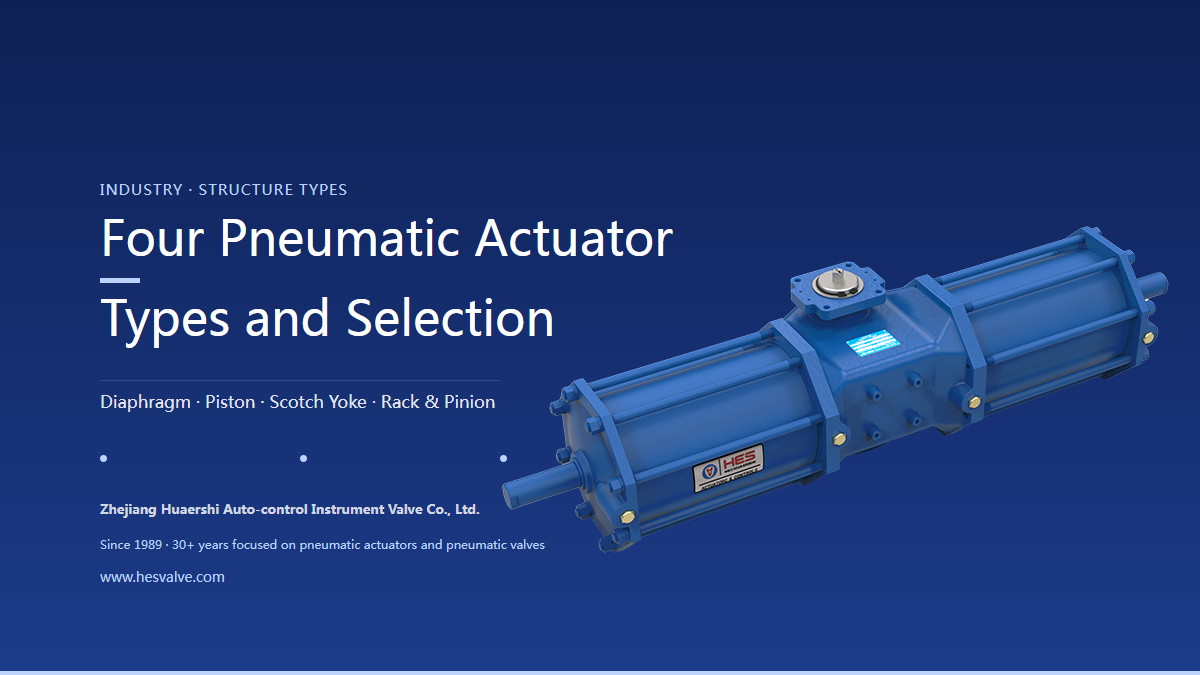
A pneumatic actuator is an actuating device that uses air pressure to drive a valve to open, close or regulate. It is also called a pneumatic actuating mechanism or a pneumatic device, though in everyday speech we usually just call it a "pneumatic head." It converts the energy of compressed air into valve movement, and it is the most common type of actuating device on automated pipelines. Starting from the definition, this article focuses on its four structural types and on how to judge the right one in actual selection.
1. Getting to Know It First: Definition and Other Names
-
Drive method: air pressure is the power source, driving the valve to open, close or regulate
-
Several common names: pneumatic actuating mechanism, pneumatic device; on site it is often colloquially called a "pneumatic head"
-
A structural feature that is easily overlooked: in a pneumatic actuator, the actuating mechanism and the regulating mechanism form a single integrated whole; the power section and the connection to the valve movement are designed as a matched set, not put together at random
-
Its basic task: receive the control signal, turn air pressure into movement, and let the valve open, close or regulate proportionally whenever needed
Although there are many names, they actually refer to the same type of device; once the definition is sorted out, the structural types will not be confusing later.
2. Four Structural Types: Diaphragm, Piston, Scotch Yoke and Rack-and-Pinion
-
Diaphragm type: a diaphragm bears the air pressure to produce thrust, usually with spring return; simple structure, relatively low cost and a short stroke, mostly used for linear-stroke control valves
-
Piston type: a piston reciprocates inside the cylinder bore to produce thrust; the output force is greater than that of the diaphragm type, and different thrust levels can be obtained by changing the bore diameter; suitable for linear-stroke applications that require greater thrust
-
Scotch yoke type: the linear motion of the piston is converted into rotary motion by a scotch yoke mechanism, and a relatively large torque can be output at both ends of the open/close travel; compact in structure, it is commonly used in heavy-duty open/close scenarios such as large-diameter ball valves and butterfly valves
-
Rack-and-pinion type: the rack meshes with the pinion to convert linear motion into a standard 90° rotation; the double-acting version outputs symmetrically on both sides, with a compact structure and strong versatility — it is the most common type on rotary valves
These four types have no absolute advantages or disadvantages; the difference lies in where each fits better. In actual installations, rotary valves (ball valves, butterfly valves) most often use the rack-and-pinion and scotch yoke types, while linear-stroke control valves are mainly diaphragm and piston types.
3. How to Choose Among the Four Types
-
Look at the valve size and the required torque: where the torque demand is large, the scotch yoke type should be considered first; for small and medium-size rotary valves, the rack-and-pinion type is more economical
-
Look at the stroke type: linear-stroke control valves mostly use the diaphragm or piston type, while 90° rotary valves use the rack-and-pinion or scotch yoke type
-
Look at installation space and weight: for positions with limited space and difficult maintenance access, a compact structure is more suitable
-
Look at air supply pressure and control accuracy: the output of the diaphragm type is directly related to air pressure, while with the piston type you need to watch the influence of friction and lubrication
Run through these points in order and the structural type is basically decided.
4. Division of Labor with Electric Actuators: Each in Its Place, Not Substituting for the Other
Besides pneumatic actuators, there is another fairly popular type of actuator today, namely the electric actuator. Both are actuators, but because of differences in technical performance they are widely applied in different situations:
-
Pneumatic actuators: can simply achieve fast linear reciprocating motion, with a simple structure and convenient maintenance
-
Electric actuators: mostly used in applications with precise motion control
Therefore, in situations involving frequent operation, harsh environments and safety shut-off, the pneumatic solution is more reliable; where fine positioning and continuous regulation are needed, the electric solution is more suitable.
5. Its Most Prominent Advantage: Good Environmental Adaptability
The most prominent feature of pneumatic actuators is their good environmental adaptability: they can be used in all kinds of harsh working conditions, such as operating conditions with explosion-proof requirements, heavy dust and high humidity. Being driven by compressed air and not depending on electricity is the fundamental reason they can adapt to these situations — this is especially evident in industries such as petrochemicals, metallurgy and water treatment.
6. Summary and Recommendations
In one sentence: a pneumatic actuator is an actuating device that uses air pressure to drive a valve to open, close or regulate (commonly called a "pneumatic head"), and its actuating mechanism and regulating mechanism form a single integrated whole; by structure it falls into four types — diaphragm, piston, scotch yoke and rack-and-pinion — each with its own suitable applications.
In selection, hold on to two main threads: first determine the structural type according to the valve's stroke type and required torque, then confirm the protection requirements and accessory configuration according to the environmental conditions. Once these two steps are done, looking at specific models and parameters afterwards will not lead you in the wrong direction.
Conclusion
The point of understanding structural types is not to memorize a few terms, but to be able to judge which type to choose, and why, when facing a specific valve. If you need structural type recommendations for a specific valve and operating conditions, you are welcome to contact our service team.
Zhejiang Huaershi Auto-control Instrument Valve Co., Ltd.
Since 1989 · 30+ years focused on pneumatic actuators and pneumatic valves
Website: