
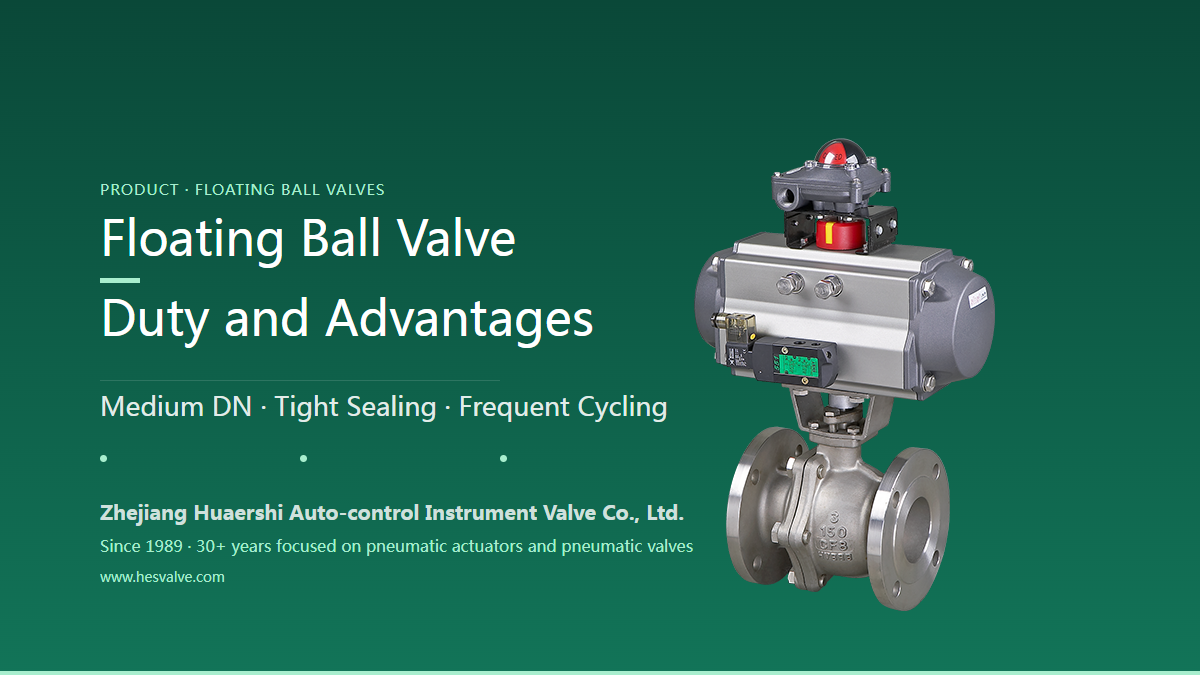
In modern industrial piping systems, valves do more than shut off, connect and regulate media - they directly affect the safety, stability and operating efficiency of the whole system. For duties with small to medium diameters, moderate pressures and frequent cycling, the pneumatic flanged floating ball valve has become widely used in petrochemicals, natural gas, power, metallurgy and water treatment thanks to its simple structure, reliable sealing and high degree of automation. This article covers what it is, which duties it suits, where its advantages lie, and which parameters matter when selecting.
1. What Is a Pneumatic Flanged Floating Ball Valve?
A pneumatic flanged floating ball valve is an automated valve that uses compressed air as the power source. A pneumatic actuator turns the stem to rotate the ball, opening or closing the pipeline to control the medium.
The crucial point is the word "floating": the ball is not carried on fixed upper and lower trunnions - it is supported by the seats on both sides. The medium pressure acts on the ball and pushes it against the downstream seat, producing a seal that gets tighter as the pressure rises. That is exactly why a floating ball valve is simple in structure and reliable in sealing.
The flanged connection further improves installation convenience and connection reliability, which is why these valves are widely used in industrial piping networks.
How it operates: after the control system sends a signal, the solenoid valve switches the air path and the positioner outputs air pressure proportionally. The pneumatic actuator drives a piston or rack-and-pinion mechanism, turning the stem 90 degrees, and the ball opens or closes accordingly. The action is direct and fast, and it does not depend on local electric power - which is the underlying reason these valves handle critical tasks in petrochemical and natural gas service.
2. Duties (Part 1): Small and Medium Diameters, Reliable Sealing at Moderate Pressure
Small and medium diameter pipelines: floating ball valves are commonly used on lines such as DN15 to DN200. As the diameter grows, the opening and closing torque rises noticeably, so the actuator output torque must be calculated from the diameter and pressure drop, with a margin left in reserve.
Moderate pressure where sealing must be reliable: a floating ball is pressed by the medium against the downstream seat, so the higher the pressure, the tighter the contact - sealing stays stable under medium pressure. It also provides bidirectional sealing, remaining reliable when the pressure direction changes from one end of the line to the other.
Both duties share the same demand - stable sealing, simple structure and sensible cost - and that is exactly where the floating design is strong.
3. Duties (Part 2): Frequent Cycling, Ex Areas and Complex Media
Frequent cycling: for systems that need automatic switching, interlock protection or high-frequency action, a pneumatic actuator responds quickly and connects seamlessly with PLC and DCS systems for intelligent remote control. The floating structure has few parts and acts directly, which also reduces the wear points under frequent operation.
Explosion-proof and remote control: because a pneumatic system runs on compressed air and produces no electrical sparks, it is especially suitable for locations with strict explosion-proof requirements such as oil, natural gas and chemical plants.
Complex media: for high flow rates, media containing impurities or special chemicals, different body materials and sealing structures (PTFE, reinforced PTFE, PPL or metal-to-metal seats) can be configured to meet a wide range of industrial needs.
4. Typical Industries
-
Oil and natural gas transmission: shut-off control for stations and branch lines
-
Chemical process lines: complex media with high demands on sealing and materials
-
Power plant steam and circulating water systems: frequent cycling, requiring fast response and high reliability
-
Metallurgy and mining conveying: heavy dust and vibration, where environmental adaptability is decisive
-
Municipal water supply, drainage and sewage treatment: mostly small and medium diameters, where ease of maintenance comes first
-
LNG and energy equipment: low temperature and explosion-proof requirements combined
5. Core Product Advantages
-
Simple, compact structure: few parts and a small footprint, which makes installation and maintenance easier
-
Excellent sealing: the higher the medium pressure, the tighter the contact, with bidirectional sealing that reduces the risk of leakage
-
Low operating torque: a direct 90-degree rotary action lets the actuator be smaller and more economical
-
High degree of automation: supports solenoid valves, positioners, limit feedback and other control accessories
-
Strong adaptability: multiple body and sealing materials cover low-temperature, corrosive and explosion-proof service
6. Selection Recommendations
When choosing a pneumatic flanged floating ball valve, evaluate these key parameters together:
-
Nominal diameter (DN)
-
Nominal pressure (PN / Class)
-
Media type and temperature range
-
Body and sealing materials
-
Flange standard and connection dimensions
-
Actuator output torque and control mode
-
Explosion-proof, anti-corrosion and special duty requirements
These parameters constrain each other: diameter and pressure drop determine actuator torque, the medium and temperature determine body and sealing materials, and the site conditions determine whether explosion-proof and anti-corrosion configurations are needed. Confirm them in the order of duty, material, torque, accessories - and avoid looking at a single indicator alone.
Two practical reminders: first, leave a torque margin - calculate it from the actual pressure drop and medium condition, not just the nominal pressure. Second, keep accessories consistent - the interfaces and signal types of the solenoid valve, positioner, limit switches and filter regulator should match, so later maintenance does not turn into a patchwork.
When to switch to a trunnion design: with larger diameters (for example DN250 and above), higher pressure drops and long-term high-frequency operation, the torque of a floating design rises noticeably, and a trunnion-mounted ball valve - where the ball is carried on upper and lower trunnions for lower torque - becomes the safer choice. Settling this point during selection keeps the solution from being revised later.
Conclusion
Thanks to its simple structure, reliable sealing and high degree of automation, the pneumatic flanged floating ball valve has become widely used in modern industrial fluid control systems. With sound selection and sensible configuration, it raises production efficiency, lowers maintenance costs and provides solid support for safe, stable operation. For selection advice based on your specific duty, please contact our service team.
Zhejiang Huaershi Auto-control Instrument Valve Co., Ltd.
Since 1989 · 30+ years focused on pneumatic actuators and pneumatic valves
Website: