
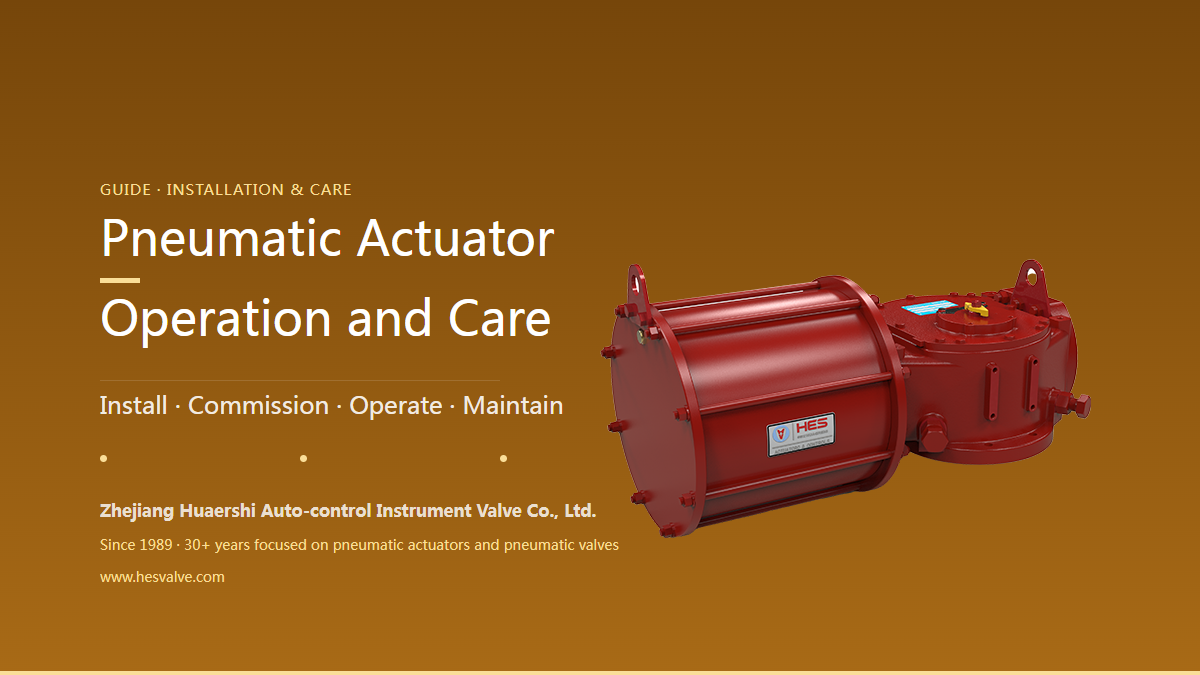
HES pneumatic actuators are widely used in many industrial fields thanks to their stable performance and reliable quality. But whether the equipment runs reliably over the long term depends largely on whether installation was done properly, commissioning followed the rules and maintenance kept to schedule. What follows is a complete set of operating instructions, covering installation, commissioning, operation and maintenance point by point.
1. Installation: From Preparation to Position
Before installation
-
Confirm that the selected model and specification fully match your application
-
Inspect the actuator housing carefully; if you find any sign of damage or deformation, replace it immediately so it does not affect installation and use
-
Thoroughly clean the installation site to keep dust and impurities out of the actuator, where they can cause faults
-
Prepare all required tools and materials in advance: wrenches, bolts, gaskets and so on
Installation
-
Mount the actuator correctly and firmly on the valve or other controlled equipment, ensuring a solid fit and a tight connection
-
Watch the mounting orientation: the actuator's direction of action must match the valve's opening and closing direction
-
Connect the air supply piping and check its sealing strictly to rule out leakage
-
Install the electrical components (such as the solenoid valve and limit switches) and wire them precisely according to the manual
2. Commissioning in Three Steps
Step 1: Check the air supply - make sure the air pressure matches the actuator's working range, usually set between 2 and 8 bar. Also pay close attention to the cleanliness and dryness of the air, so impurities do not enter the actuator, interfere with operation and shorten service life.
Step 2: No-load test run - with no load connected, turn on the air supply and let the actuator run unloaded. Watch closely whether the action is smooth and free, and whether there is any sticking or creeping.
Step 3: Load test run - connect the load and turn on the air supply again. Check that the actuator delivers enough driving force under load and completes the opening, closing or regulating action accurately and steadily.
Once all three steps pass, put the unit into continuous operation - this avoids most of the "it does not work once installed" problems.
3. Operation (Part 1): Single-Acting and Double-Acting
Single-acting actuators are usually designed as normally open or normally closed. A normally open unit closes the valve when air is supplied and opens it when the air is cut off; a normally closed unit works the other way round, opening on air supply and closing when air is cut. The value of this design is that, in the event of an air failure or emergency, the spring return automatically moves the valve to a safe position - effectively safeguarding system stability and safety.
Double-acting actuators take air through different ports to control opening and closing separately. When air enters from one side, the piston drives the valve open; when it enters from the other side, the piston drives the valve closed. This symmetrical control gives them efficient, stable performance in complex duties that require frequent switching.
4. Operation (Part 2): Regulating Control
In processes that require precise regulation, HES pneumatic actuators can regulate the valve by adjusting the air supply pressure or the control signal. Used together with professional accessories such as a high-accuracy positioner, regulation accuracy improves further, ensuring accurate and stable fluid control.
A simple way to tell the two requirements apart: on/off service cares whether the valve reaches position, regulating service cares whether it is accurate - and the latter is more sensitive to the positioner and air quality, so consider both during selection and commissioning.
5. Maintenance Essentials
Regular inspection
-
Appearance: check for damage, deformation or leakage, and deal with any issue as soon as it appears
-
Air supply piping: check that every connection is properly sealed with no sign of leakage
-
Electrical connections: check that they are secure, with no looseness or damage, to avoid unexpected downtime caused by electrical faults
Lubrication
-
For models that require lubrication, add good-quality grease or oil strictly on schedule to reduce friction and wear between moving parts and keep the action responsive and reliable
-
While servicing, inspect the seals for wear; replace any that are aged, damaged or seriously worn so that poor sealing does not lead to leakage
6. Long-Term Storage and Idle Management
If the actuator stays idle for a long time, carry out an action test periodically - once a quarter is generally recommended - to prevent rusting or seizing from prolonged standing and to keep the unit ready for use.
Store it in a dry, clean environment, protected from moisture and corrosion and kept away from harmful gases and strong electromagnetic interference, so that performance is unaffected under good storage conditions.
Conclusion
With their excellent performance, reliable quality and complete service system, HES pneumatic actuators have become key components in many industrial automation control systems. Operating and maintaining them as described above brings out their performance advantages and keeps production efficient and stable. If you have any questions during use or need further technical support, please contact the HES professional team at any time.
Zhejiang Huaershi Auto-control Instrument Valve Co., Ltd.
Since 1989 · 30+ years focused on pneumatic actuators and pneumatic valves
Website: