
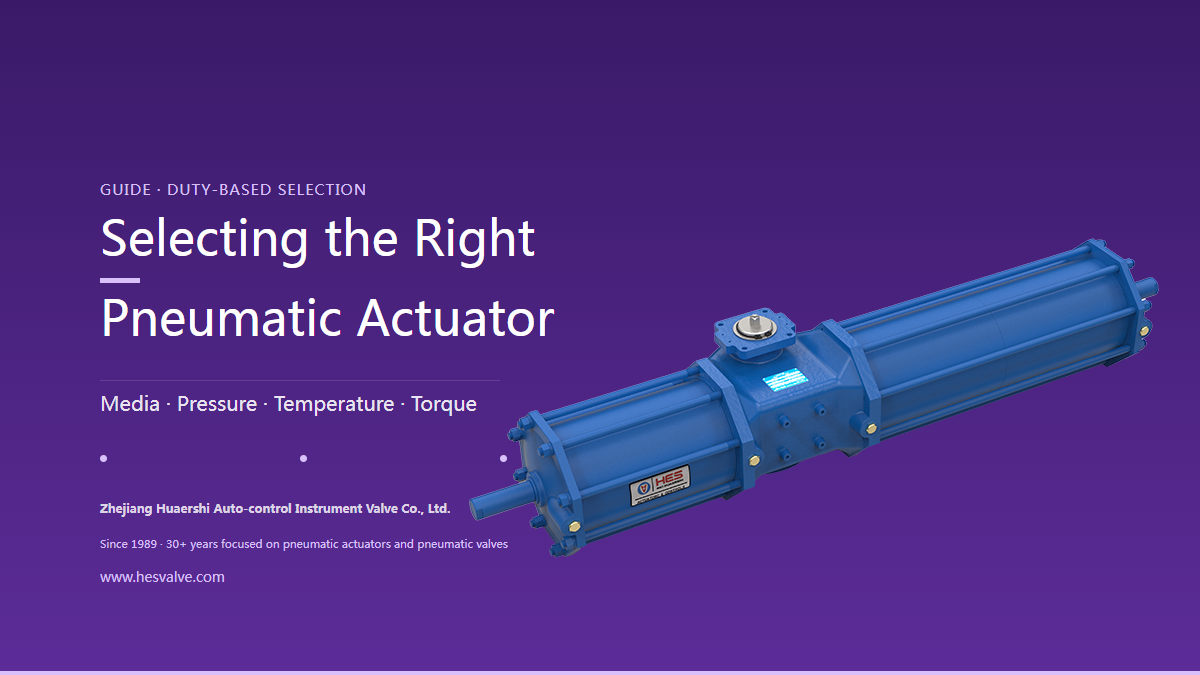
In stainless steel piping and industrial automation systems, the pneumatic actuator is the key link between the control signal and the valve movement. With different media, pressures, temperatures and control requirements, poor selection quickly shows up as insufficient torque, sluggish or sticking action and a greater risk of leakage. What follows is a practical, field-oriented approach to fast selection - four filters that narrow the choice step by step, so you can match the right HES pneumatic actuator efficiently.
1. Filter One: Media, Pressure and Temperature Confirmed at Once
Media characteristics: for acid or alkaline solutions, media containing chloride ions or humid coastal sites, choose a stainless steel cylinder body or enhanced anti-corrosion treatment, and select corrosion-resistant seals such as PTFE. For clean duties such as food and drinking water, the focus shifts to food-grade sealing and an easy-to-clean structure.
Pressure rating: for ordinary clean water and stainless steel water supply and drainage lines, most duties fall within 1.0 to 1.6 MPa, where a standard pneumatic actuator is sufficient. High-pressure duties such as high-pressure steam or chemical reaction lines require a higher pressure rating and safety factor to avoid fatigue failure in long-term operation.
Temperature range: normal to medium temperatures can use a standard sealing configuration; for high-temperature steam or low-temperature outdoor installation, confirm the temperature resistance of the seals and the stability of lubrication and coatings as temperature changes.
Once these three points are stated clearly, the material grade and structural type of the actuator are largely defined.
2. Filter Two: Valve Type and Control Requirement Decide the Actuator Type
Valve type first
-
Ball valves and butterfly valves: use a rotary pneumatic actuator - compact, with high output torque, mainly for on/off duty or simple regulation
-
Gate valves and globe valves: usually paired with a linear actuator, suitable for fine linear regulation
Then the control requirement
-
Shut-off valves used purely for on/off control: a double-acting pneumatic actuator is preferred - crisp action, well suited to frequent starts and stops
-
Applications where fail-safe matters (chemical plants, toxic media, pressurized storage tank lines): choose a single-acting actuator with spring return and set fail-open or fail-close as the process requires, so a safe valve position is maintained on power or air failure
-
Systems needing proportional regulation and precise flow control: fit an electro-pneumatic valve positioner on the selected actuator and link it to the host system through a 4-20 mA signal for continuous valve positioning
With the valve type and control mode settled, the matching actuator platform can be found quickly.
3. Filter Three: Torque and Safety Factor - Neither Oversized Nor Underpowered
Most field problems trace back to poor torque selection.
Start from the valve operating torque given by the valve manufacturer, then apply a sensible safety factor based on media, pressure, temperature and cycling frequency: a lower factor is acceptable for ordinary clean water at ambient temperature, while high temperature, high pressure, particle-laden media or frequent cycling call for a larger margin.
The key is to calculate the matching torque range and cylinder bore from the actual on-site air supply pressure rather than the ideal value in the catalogue - only then will the actuator deliver enough torque under real air conditions, avoiding the "fine on paper, underpowered on site" trap.
4. Filter Four: Installation Space and Air Supply Conditions
Inside equipment piping and compact skids, actuator size is an important constraint. Where piping is dense and headroom is limited, consider a thin-profile pneumatic actuator to reduce overall height and the risk of interference with piping or the equipment housing. For vertical, horizontal or other special mounting arrangements, confirm in advance that the output shaft direction, rotation angle and stem design all match, adapting them with dedicated couplings or brackets where necessary.
At the same time, verify the stability of the on-site air supply: in many plants the actual supply pressure fluctuates between 0.4 and 0.6 MPa, so selection should be based on that range rather than an ideal figure, ensuring the actuator still acts reliably at the low end.
5. Accessories and Function Expansion
-
Fit a limit switch box to feed back the valve position signal for interlocking with PLC and DCS systems
-
In flammable or explosive areas, choose actuators and electrical accessories with the appropriate explosion-proof rating
-
Add a handwheel or manual override for maintenance or emergency operation when the air supply fails
Combined, these accessories cover both basic on/off control and the requirements of different levels of automation and safety standards.
6. Before You Submit a Selection Request: Eight Items to Prepare
-
Media name, concentration or cleanliness requirement
-
Working pressure and maximum pressure (is it a high-pressure duty?)
-
Media temperature and ambient temperature (high temperature, outdoor low temperature?)
-
Valve type, size and valve operating torque
-
Control mode: on/off shut-off or proportional regulation, and whether fail-open or fail-close is required
-
Actual on-site air supply pressure range and fluctuation
-
Installation space limits and mounting arrangement (vertical, horizontal or special angle)
-
Automation level and accessory requirements (limit feedback, explosion-proof, handwheel, etc.)
With this information ready, selection usually locks onto the right specification in one pass, saving repeated back-and-forth.
Conclusion
Pneumatic actuator selection looks complex, but in essence it is a step-by-step screening around three things: duty, valve and control mode. Once the media, pressure, temperature, valve type and control requirements are clear, and torque, safety factor and installation conditions are taken into account, the right solution can be found quickly in the HES actuator range. For detailed calculations or customized designs on a specific project, send us the valve model, piping parameters and control requirements - the HES technical team provides one-to-one selection support and complete matching advice.
Zhejiang Huaershi Auto-control Instrument Valve Co., Ltd.
Since 1989 · 30+ years focused on pneumatic actuators and pneumatic valves
Website: