






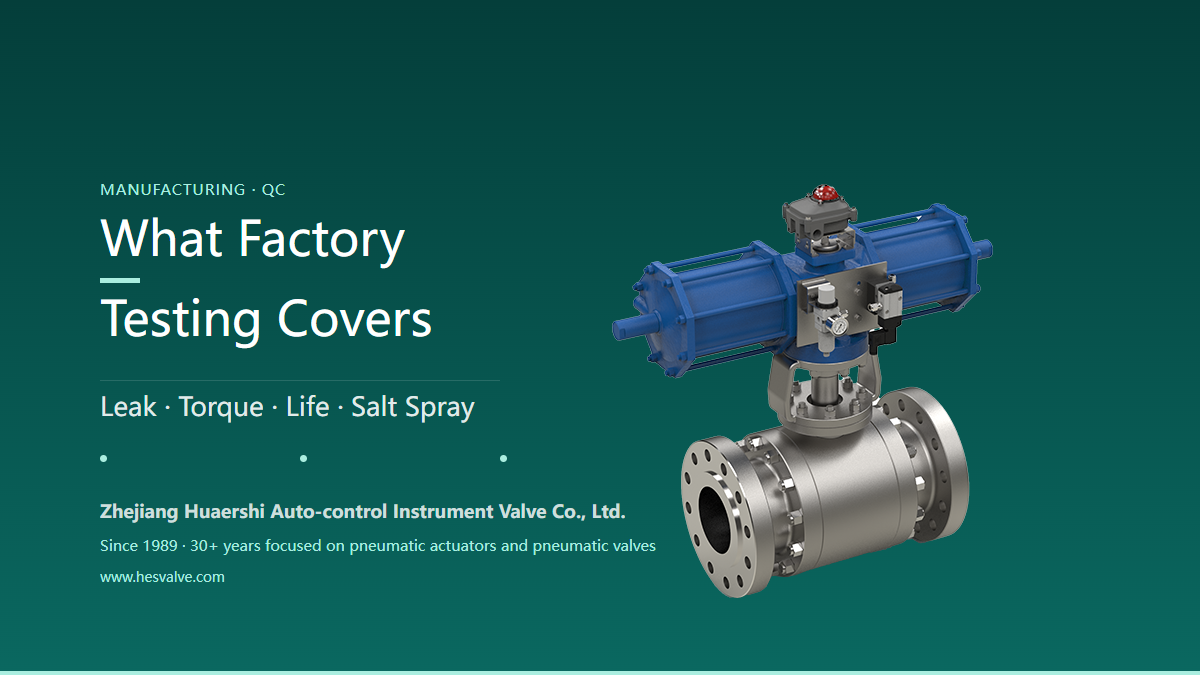
Pneumatic actuators are core components of industrial pipeline automation, and their quality stability directly affects the operational safety of the entire production line. In recent years, as automation upgrades in chemicals, water treatment, oil and gas, and power continue to advance, searches for "pneumatic actuator manufacturer recommendations," "legitimate manufacturers," and "production enterprises" have kept rising—buyers no longer look only at price, but care more about one thing:whether this company has a complete quality inspection process and whether factory acceptance testing is actually performed. Cases of falsely stated parameters, insufficient torque, and incomplete valve switching occur frequently in the market, and "how strict the factory acceptance testing is" has become a key benchmark for judging whether a supplier is reliable. This article breaks down and explains this inspection checkpoint.
I. Why factory acceptance testing has become the benchmark for selecting a factory
Factory acceptance testing is not the final formality before a product leaves the line, but a systematic project that runs through the entire manufacturing process. The most direct way to judge an actuator factory is not to look at catalog parameters, but to ask three questions:
-
Atwhich stagesis testing performed, and after which process step is it positioned?
-
Whatin-house laboratories are there, and which items are tested?
-
Test datais it retained, and can it be provided?
If these three questions cannot be answered truthfully, the parameters are only numbers on paper.
II. Four stages across the whole process: if any stage fails to meet the standard, it does not proceed to the next
Huaersi's quality inspection system covers four stages, and each stage has clear non-release conditions:
-
Incoming raw materials: The material composition, hardness, and dimensional accuracy of key materials such as cylinder bodies, seals, and gear shafts are verified one by one, eliminating the use of substandard materials at the source
-
Precision machining:Combining in-process sampling inspection with first-article inspection; the dimensional tolerances of the cylinder inner wall and the meshing accuracy of the gear rack directly determine the output torque and the smoothness of opening and closing
-
Assembly and debugging: Standardized work procedures; after each unit is assembled, first perform ano-load operation testto confirm flexible movement and no jamming
-
Finished product testing: Enter the laboratory for full testing; only after passing is packaging and warehousing permitted
The purpose of setting up checkpoints at every stage is:problems are discovered at the cheapest stage. If a batch of nonconforming material is found at the raw material stage, the cost is a few hundred yuan; if a seal leak is only discovered at the customer site, the cost is one downtime.
What each of the three or four tests intercepts
Many users report that the actuators they purchase develop seal leaks, slow action, or even jamming before long—the root cause is often that factory inspection has become a mere formality. Hualshi is equipped with professional laboratories for salt spray testing, life testing, torque testing, and airtightness testing, and every product undergoes full testing before leaving the factory:
-
Airtightness: intercepts internal and external leaks—if not done, the consequence ranges from slower response to the valve failing to open or close fully
-
Torque: intercepts deviation between measured values and nominal values—failure to open or close fully under the rated pressure differential amounts to falsely rated parameters
-
Service life: prevents performance degradation after long-term operation—failures occur after tens of thousands of cycles on site, and maintenance costs exceed the purchase price
-
Salt spray: prevents material degradation in corrosive environments—rust and sticking occur within six months at coastal and chemical sites
Under normal operating conditions, equipment can achievehundreds of thousands of cycles; the cylinder useshard-anodized aluminum alloy process, wear-resistant and corrosion-resistant. Accelerated life testing and salt spray corrosion testing simulate exactly these harsh on-site conditions—high temperature, high pressure, and severe corrosion—the extra time spent in the lab means fewer production line shutdowns on site.
IV. Certification System: Test Data Must Be Auditable
The credibility of factory testing cannot be separated from the support of a quality management system. Hualishi is a national high-tech enterprise and a technology-based small and medium-sized enterprise, holdingmore than twenty national patentsand having passedeight authoritative certifications: ISO9001 quality management system, occupational health and safety management system, environmental management system; some products have obtained SIL functional safety certificationand CE certification, and holds theSpecial Equipment Manufacturing License.
These three types of certification each address one thing:
-
ISO9001: requires that inspection records befully traceable—every actuator has a file from raw material batch to inspection data, and a complete factory inspection report can be provided upon customer request
-
CE/SIL: sets mandatory requirements for safety performance; products exported to markets such as Russia, Southeast Asia, and the Middle East must adapt to different project standards, and certification drives continuous improvement of inspection standards
-
Special Equipment Manufacturing License: Valve products involving special operating conditions are manufactured and tested in accordance with licensing requirements, providing peace of mind for explosion-proof, emergency shutdown and other such applications
V. Results: How the repair rate came to be below 2%
The ultimate value of the quality inspection process is reflected in actual customer use. Hualshi productsrepair rate below 2%, and behind this figure is the direct return on strict factory inspection:
-
Defects stopped at the factory: Compared with discovering problems only after the equipment reaches the site and shutting down for troubleshooting, in-factory inspection carries far lower cost and risk
-
Cost-effectiveness remains: Compared with similar imported products, the procurement cost is approximately that of imported brands 40% or so, ensuring performance through a complete quality inspection system rather than cutting prices to win orders
-
Case evidence: pipeline automation upgrade at a plate metallurgy plant, where high-torque fork-type actuators replaced imported equipment,cutting the delivery lead time in half, with stable operation; customer feedback was "stable quality, complete certifications, and years of use without any problems"
VI. Frontline operating conditions are the ultimate test
The significance of factory testing must ultimately be verified in complex field conditions:
-
Municipal wastewater treatment: pneumatic butterfly valves and actuators supplied as complete sets for sedimentation tanks and chemical dosing pipelines, with equipment operating stably and helping the customer reduce later maintenance costs by about 30%
-
Chemical RTO waste gas treatment: Explosion-proof pneumatic ball valves and actuators are adapted to explosion-proof working conditions in the workshop, ensuring safe opening and closing of waste gas pipelines
-
Specifications cover: Actuator torque 8–6000 N·m, compatible with DN15–DN800, standard models 7–15 daysDelivery: full-process independent quality inspection at the Wenzhou and Shanghai production bases
The more complex the operating conditions, the more corrosive the medium, and the higher the opening and closing frequency, the more directly the strictness of factory testing determines equipment lifespan and maintenance costs.
Conclusion
What exactly is factory testing measuring? On the surface, it is four sets of data: air tightness, torque, lifespan, and salt spray. In essence, it is measuring a company'squality bottom line—whether it is willing to pay the cost for processes that cannot be seen.
If you are screening actuator suppliers, or need to verify the test reports and qualifications of a certain batch of products, send us your operating conditions: you can obtain free operating condition assessment and selection support, and you can also request complete product test reports and certification materials.
Zhejiang Huaershi Automatic Control Instrument Valve Co., Ltd.
Founded in 1989 · Over thirty years of focus on pneumatic actuators and pneumatic valves
Official website: