






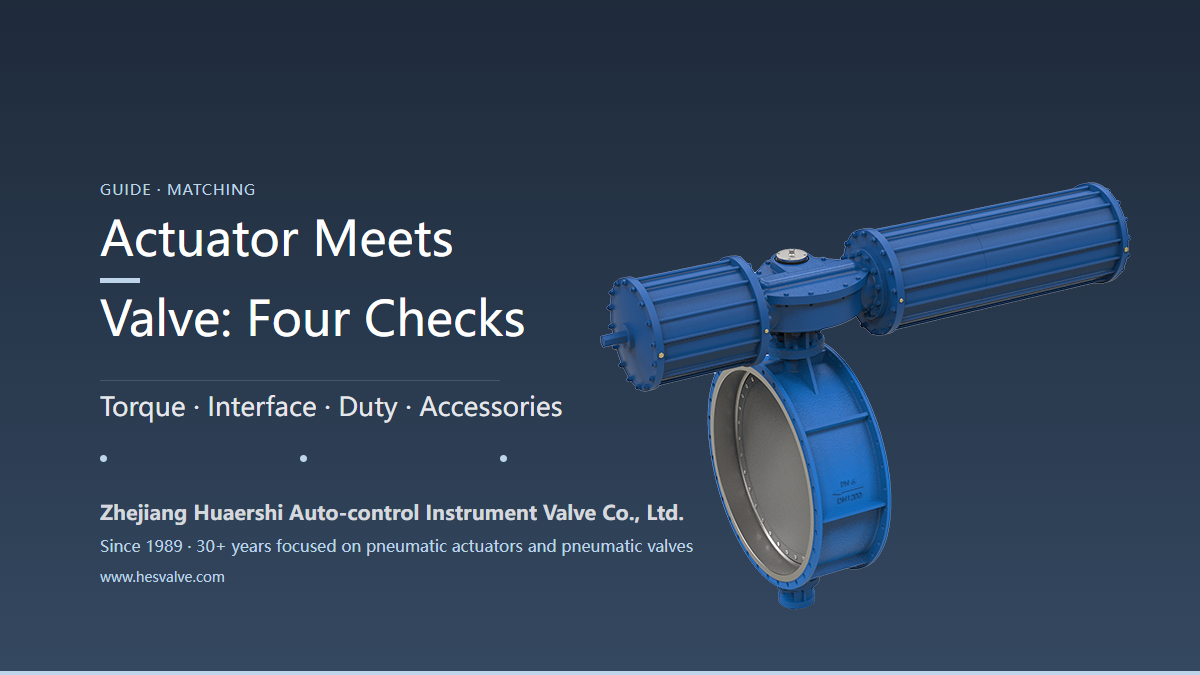
What troubles many engineers and buyers most is not finding a pneumatic actuator, butmismatched pairing: insufficient torque means the valve won't open, while excessive torque damages the valve stem; interface dimensions don't line up, and installation rework happens frequently. Searching for "recommended pneumatic actuator manufacturers," "brands," or "suppliers," the real unavoidable task is judging whether the pairing matches. Hualishi has been providing integrated actuator and complete valve packages for over thirty years, breaking this down into four "matches" —torque, interface, operating conditions, accessories.
1. First look at the symptoms: what a mismatch looks like
-
Insufficient torque: the valve doesn't open fully or close tightly, media leaks internally, and repeatedly adjusting the stroke doesn't help
-
Excessive torque: the valve stem is twisted or even broken, the seat seal is crushed, and service life is greatly shortened
-
Incorrect interface: flange hole positions, shaft diameter, and keyway do not match; adapters are added on site, and coaxiality deviation causes jamming and uneven seal wear
-
Mismatched accessories: solenoid valve voltage does not match the control cabinet, limit switch feedback type is wrong, air supply pressure does not match the rated value, and remote control fails directly
These four symptoms almost all come from the same source:the actuator and valve are not designed as a matched set.
II. First check torque: allow a 30%–50% margin
The first factor in determining whether a pairing matches is torque. The actuator output torque must exceed the maximum torque required to open the valve, with a reasonable margin left—a general recommendation is 30% to 50%—to account for fluctuations in medium pressure differential, increased packing friction, and rising actuation resistance after long-term use.
Note two points during calculation:
-
Calculate separately by valve type: ball valves, butterfly valves, and gate valves have completely different opening and closing torque characteristics, and the difference at the same nominal size may be large; one coefficient cannot be applied to all
-
Use measured values, not nameplate ratings: many manufacturers overstate parameters; the nameplate torque may look sufficient, but the actual output is insufficient. Every Hualshi actuator undergoesmeasured torque testingbefore leaving the factory, so the parameters are real and verifiable
Torque coverage 8–6000 N·m, with corresponding models available from DN15 small-diameter ball valves to DN800 large-diameter butterfly valves.
3. Second, check the interface: ISO5211 is only the starting point
Once the torque calculation is accurate, the second step is to confirm the mechanical interface, focusing on two points:
-
Shaft connection: whether the dimensions, keyway form, and shaft end shape of the actuator output shaft and the valve stem match
-
Mounting hole positions: whether the actuator, bracket, and valve conform to ISO5211 Hole positions and spigot dimensions conforming to international standards
The cost of mismatched interfaces is not just money: on-site extra machining of adapters introducescoaxiality deviation, which in turn leads to sluggish operation and uneven seal wear—problems that only surface months after commissioning. Hualishi actuators and valves are independently developed and produced as an integrated unit, with connection dimensions match-designed before leaving the factory, so成套采购可be installed directly, ready to use out of the box; if the customer already has a valve and only wants to add a matching actuator, the technical team will also verify the valve stem dimensions and flange standard and provide the correct connection solution.
4. Third look at operating conditions: can the material and seals withstand them
Many matching failures are not parameter problems but operating condition problems—highly corrosive media, excessively high or low temperatures, explosion-proof requirements, and limited installation space all change the selection conclusion.
-
Process: the cylinder usesHard anodized aluminum alloy construction, wear-resistant and corrosion-resistant; under the same operating conditions, the service life of the complete unit is better than that of ordinary domestic products, and under normal operating conditions it can achievehundreds of thousands of cycles
-
Corrosive conditions: For chemical, waste gas treatment and similar applications, the valve body material and sealing material can be customized and adjusted
-
Explosion-proof applications: Explosion-proof configurations can be provided for oil and gas and chemical workshops
-
Structural options: Large-torque scotch yoke type is suitable for demanding conditions with high pressure differential and large diameter; rack-and-pinion type is suitable for conventional opening/closing and angle adjustment
When selecting a model, specify the medium, pressure, temperature and explosion-proof rating clearly so that the supporting equipment can truly withstand the site conditions.
5. Fourth, check the accessories and signals: the entire loop must be able to communicate
A complete pneumatic control loop, in addition to the actuator and valve, also requiressolenoid valves, limit switches, and air filter pressure reducing valves. Improper accessory selection can likewise cause the entire system to mismatch:
-
Solenoid valve voltage signal does not match the control cabinet → remote commands cannot be sent
-
Limit switch feedback form does not match → the host computer cannot see the actual valve position
-
Air supply pressure does not match the actuator rated pressure → weak action or seal damage
Huaershi provides a full set of control accessoriesone-stop complete supply, and the accessories and actuator are completed before leaving the factoryjoint commissioning, with signals, air circuits, and feedback all matched in place, so it can be put into operation once connected to the air supply on site, greatly reducing commissioning difficulty and downtime risk.
VI. Scenarios and fundamentals: supporting work done upfront makes the back end worry-free
On-site verification:
-
Municipal wastewater treatment: Pneumatic butterfly valves and actuators supplied as complete sets are used in sedimentation tanks and chemical dosing lines, with matched supporting components and reliable sealing, helping the customer reduce later maintenance costs by about 30%
-
Chemical RTO waste gas treatment: Explosion-proof pneumatic ball valves and actuators supplied as complete sets are adapted to workshop explosion-proof working conditions, ensuring safe on-off control of waste gas lines
-
Metallurgical pipeline retrofit: High-torque scotch yoke actuators replace imported units, with procurement cost about 40% of imported brands,and lead times cut in half
Established base: Technology development began in 1989, with two major bases in Wenzhou and Shanghai,100 series and models,and more than 20 national patents, ISO9001, CE, special equipment manufacturing license, etc. 8 authoritative certifications, productsrepair rate below 2%, standard models 7–15 daysdelivery, exported to Russia, Southeast Asia, the Middle East and more than ten other countries.
Conclusion
Matching is complicated to describe but simple in essence: four things must line up:torque matches, interface matches, working conditions match, accessories match. If all four match, the only remaining step on site is to connect the air supply.
If you are struggling with matching and selection—unsure how to calculate torque, how to match interfaces, or how to adapt to operating conditions—send us the valve model, medium, pressure and temperature, and explosion-proof requirements: get free operating condition assessment and selection support, or request complete matching solutions and quotation materials for your project.
Zhejiang Huaershi Automatic Control Instrument Valve Co., Ltd.
Founded in 1989 · Over 30 years focused on pneumatic actuators and pneumatic valves
Official website: