






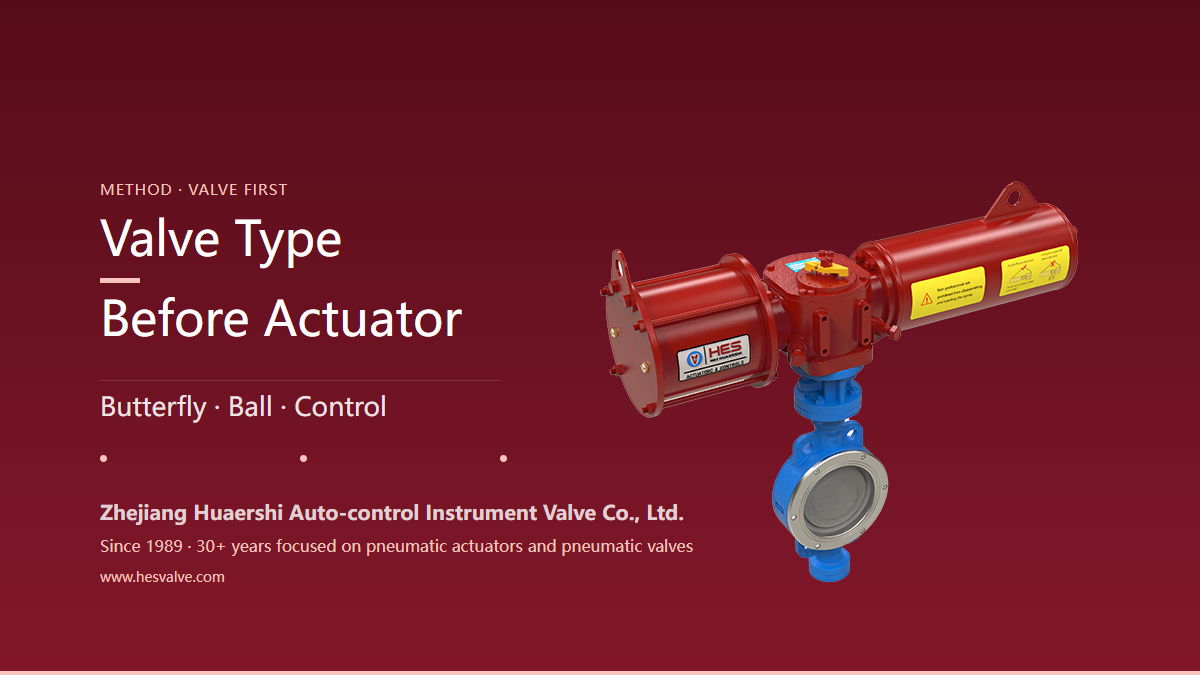
When purchasing pneumatic butterfly valves, pneumatic ball valves, and pneumatic control valves, the most common mistake isstarting the selection with the actuator: comparing torque, brands, and prices, only to find out in the end that the valve type itself is wrong. The real order should be reversed—first determine the valve type, then match the actuator. Hualishi has been making actuators and complete valve packages for more than thirty years. In selection consultations, the first question is never "how much torque do you need," but "does this pipeline need on/off control or modulating control?"
I. The dividing line between the three valve types: one sentence each
-
Pneumatic butterfly valve: the disc rotates 90° to open and close. Short face-to-face dimension, light weight, low cost,First choice for large-diameter on/off service; low flow resistance and fast opening/closing, but sealing class and temperature/pressure resistance are limited by the structure, so it is not suitable for high-precision control
-
Pneumatic ball valve: the ball's through-bore rotates 90°, giving almost zero flow resistance; soft sealing can achievezero leakage; suitable for fast shutoff and viscous or particle-laden media; the larger the diameter, the faster the cost rises
-
Pneumatic control valve: changes the flow area via valve plug displacement, enablinglinear or equal-percentage flow characteristics, used for continuous control of pressure, flow and temperature; a positioner is required to execute commands such as "open to 43%" accurately
In one sentence:For on/off, look at butterfly valves and ball valves (choose butterfly valves for large diameters, ball valves for zero leakage); for regulation, look at control valves.
II. Four questions determine the valve type
Selection does not require memorizing parameter tables; simply answer four questions in order:
-
On/off or regulation: Only two states, open/closed → butterfly valve or ball valve; needs to change continuously according to a signal → control valve
-
Diameter and pressure differential: DN200 and above, prefer butterfly valves; when high pressure differential and large diameter occur together, consider whether the actuator torque is sufficient and whether a scotch-yoke type is needed
-
Media characteristics: For corrosive media, consider the valve body and seal materials; for media containing particles or viscous media, avoid the clamped structure of hard-sealed butterfly valves; for high cleanliness requirements (pharmaceutical, food), prefer the stainless steel series
-
Temperature and sealing class: Soft seals fail under high-temperature conditions, so metal seals are required; where zero leakage is required, soft-seated ball valves are more reliable
Once these four questions are answered, the valve type is basically determined. Skipping any one of them may mean fixing things on site by modifying piping or replacing valves.
III. Once the valve type is determined, select the actuator
The valve type determines the motion form, and the motion form determines the actuator type:
-
Butterfly valves, ball valves → quarter-turn: Pair with rack-and-pinion (AT, AW series) or high-torque scotch-yoke (HG series) actuators for direct torque transmission
-
Control valves → linear stroke or quarter-turn: Linear-stroke actuators provide linear thrust and pair with control valve plugs; pair with a positioner for precise valve position control
When matching, three numbers must align:Required torque(including 30%–50% margin),air supply pressure(converted based on on-site 4–7 bar, not catalog air pressure),interface standard(shaft diameter and ISO5211 hole pattern). Hualishi actuators cover 8–6000 N·m, compatible with DN15–DN800, available in both single-acting and double-acting; actuators and valves are independently developed and produced as an integrated unit, with complete matching and commissioning performed before delivery, greatly reducing compatibility-related failures.
IV. Complex conditions require customization: where standard models cannot reach
Conditions in chemical, oil and gas, and waste gas treatment sites vary greatly—high temperature, high pressure, strong corrosion, explosion protection, emergency shutdown—and standard models often cannot directly meet them, which is also the most error-prone part of selection.
Huaersi can customize and adjust valve body material, sealing material, output torque, and protection rating according tomedium corrosiveness, pressure and temperature rating, explosion-proof requirements, and installation space. For example, in chemical RTO waste gas treatmentprojects, the explosion-proof pneumatic ball valves and actuators are solutions specially adapted for workshop explosion-proof conditions.
Before purchasing, you canfor freeconduct condition assessment and selection calculation to avoid two common types of errors:The torque was selected too low, so the switch does not reach position, the wrong material was selected, so it is not corrosion-resistant.
V. The foundation of quality: over thirty years and full-process quality inspection
The service life of a pneumatic actuator depends on cylinder body craftsmanship, sealing material, and structural design; low-priced products often cut costs in these invisible places.
-
Technology evolution: technical starting point in 1989, first generation in 1997 QGH seriesbroke foreign monopolies, and thereafter underwent GT, AT/AW/HG Multiple generations of iteration
-
Patents and qualifications:20 additional national patents, national high-tech enterprise, technology-based SME
-
Process: The cylinder adoptshard anodized aluminum alloy process, wear-resistant and corrosion-resistant; under the same working conditions, the overall service life is superior to ordinary domestic products, and under normal working conditions it can achieveHundreds of thousands of cycles
-
Quality control: A full-process system covering raw material incoming inspection, precision machining, assembly and commissioning, and finished-product airtightness, torque, and life testing; every unit undergoes full inspection before leaving the factory,with a repair rate below 2%; multiple authoritative certifications such as ISO9001 and CE
VI. Delivery and Service: Truly Putting Selection Solutions into Practice on Site
-
Lead time: Standard models 7–15 days, custom models scheduled according to demand—compared with imports that often take months, project milestones are better guaranteed
-
Cost: Compared with similar imported products, the procurement cost is approximately that of imported brands 40%
-
Case: For the pipeline automation upgrade of a plate metallurgy plant, large-torque fork-type actuators replaced imported ones, cutting the delivery lead time in half; the complete sets of pneumatic butterfly valves and actuators at a municipal wastewater treatment plant have operated stably over the long term, helping the customer reduce later-stage maintenance costs by approximately 30%
-
Service: Supported by the two major bases in Wenzhou and Shanghai for response, providing technical guidance, troubleshooting, and rapid supply of spare parts
Scenario coverage: Water treatment (on/off and flow regulation of sedimentation tanks and dosing pipelines), chemical (safe shutoff under corrosive and explosion-proof conditions), oil & gas and power (remote on/off and regulation of high-temperature and high-pressure pipelines), pharmaceuticals and food (high cleanliness and sealing requirements, met by the stainless steel series).
Conclusion
The logic of selection actually comes down to just three steps:First clarify the medium and operating parameters → then determine the valve type and torque specification → finally configure the control accessories and verify. With the right order, selection is no longer a matter of luck.
If you are struggling with the selection and matching of butterfly valves, ball valves, and control valves, send us the medium, size, pressure and temperature, explosion-proof requirements, and air supply pressure—get a free operating condition assessment and selection plan, or book an on-site visit to our two major production bases in Wenzhou and Shanghai.
Zhejiang Huaershi Automatic Control Instrument Valve Co., Ltd.
Founded in 1989 · Over thirty years of focus on pneumatic actuators and pneumatic valves
Official website: