






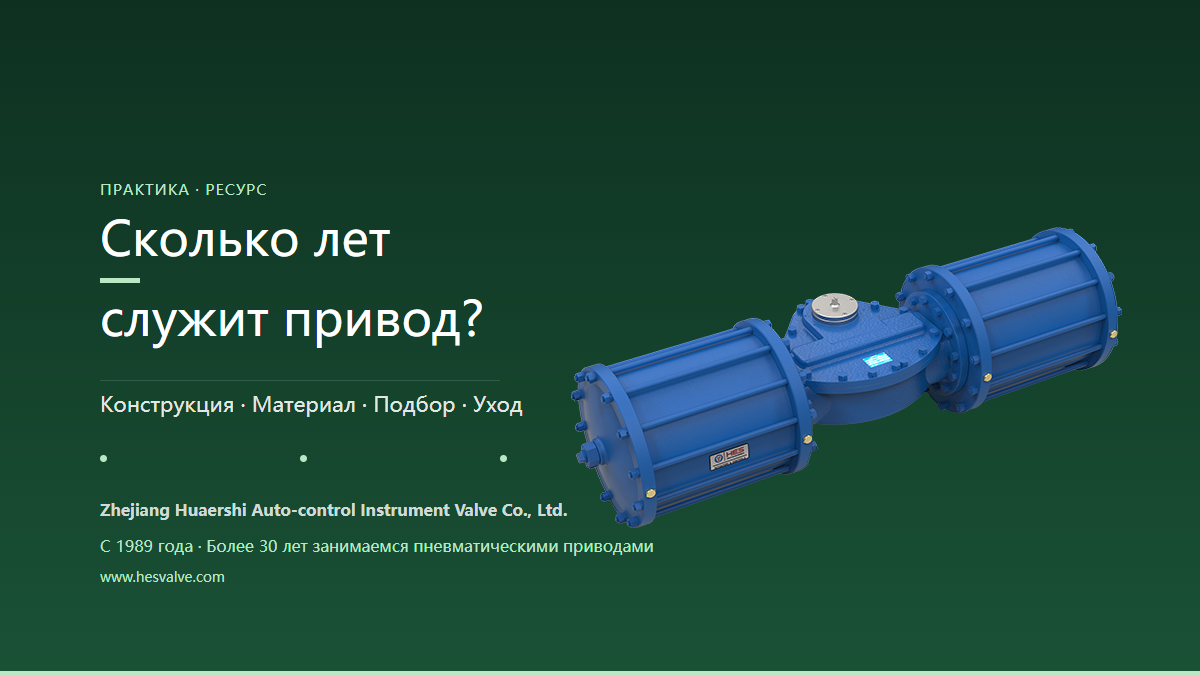
"Once this pneumatic actuator is installed, how long can it actually last, and is it stable?" This is a question almost every procurement engineer and equipment manager repeatedly ponders. From chemical, water treatment to oil and gas, power, metallurgy, and pharmaceuticals, more and more production lines rely on actuators for remote opening/closing and regulation of valves; yet the uneven market, inflated specifications, and frequent failures under harsh working conditions have also made "lifespan" the thing people really want to ask about when searching for "large manufacturers," "high-quality manufacturers," and "professional production."
What determines lifespan ultimately comes down to four things:structure and craftsmanship, materials and surface treatment, working condition adaptation and selection, full-process quality control and after-sales. In addition, there are three ways of usage that will cut lifespan in half for no reason.
I. Structure and transmission: the innate foundation of lifespan
The most core wearing parts inside the actuator are the cylinder and transmission mechanism. Whether the structural design is reasonable directly determines the fatigue life under high-frequency opening and closing.
-
The transmission form must match: The rack-and-pinion structure is compact and operates smoothly, suitable for conventional on/off and regulation; the high-torque scotch yoke type distributes force more evenly during high-torque output, suitable for large-diameter valves and high-pressure differential occasions.Using a small structure to bear large loads inevitably shortens service life significantly
-
Differences across multiple generations of iteration: Hualshi technology R&D originated in 1989, launched the first generation in 1997 QGH, completed the second generation in 2004 GT iteration, and thereafter successively expanded AT, AW, HG, DRSC product line; each generation has improved structural stress and sealing fit
-
Leave a torque margin: many manufacturers overstate specifications, actual output is insufficient, valves do not open or close fully, actuators run overloaded for long periods, and service life is naturally short. Torque coverage 8–6000 N·m, compatible with DN15–DN800, with sufficient margin left according to actual working conditions, normal working conditions can achieve opening and closing up tohundreds of thousands of cycles
II. Material and surface treatment: the foundation for corrosion and wear resistance
No matter how good the structure is, if the material is not up to standard, it is useless. Actuators year-round face moisture in compressed air, corrosive media on site, high or low temperatures, and material is the second critical factor.
-
Cylinder body material and process: The cylinder useshard-anodized aluminum alloy process, with high surface hardness, wear resistance and corrosion resistance. Under the same working conditions, the service life of the whole machine is better than that of ordinary domestic products—the difference is especially obvious in corrosive environments such as chemical and waste gas treatment
-
Seals: Seals of ordinary actuators are prone to aging and failure under corrosive and high/low temperature conditions, which is the main cause of frequent failures; seal materials can be customized according to medium corrosiveness and pressure/temperature ratings
-
Protection rating: Explosion-proof occasions, outdoor humid environments and dusty workshops have completely different requirements for protection ratings; protection ratings and explosion-proof configurations can be customized according to on-site working conditions,avoiding premature scrapping caused by forcing standard machines into special working conditions
III. Selection and working condition adaptation: many "short-lived" cases are caused by wrong selection and misuse
Short equipment lifespan is often not a problem with the product itself, but with selection. This is the most easily overlooked link in the industry, and the one that costs customers the most.
-
The cost of selection errors: If the torque is selected too low, the valve cannot open or close fully; if too high, costs are wasted and impact is greater; if the medium is misjudged, the valve body and seals will quickly corrode.
-
Free selection service is standard, not a giveaway: In the early stage, comprehensive judgment is made based on medium characteristics, pressure and temperature, explosion-proof requirements, and installation space to avoid errors at the source—this step appears to generate no direct revenue, yet directly determines the equipment's performance over the next five to ten years.
-
One-stop matching reduces compatibility failures: When actuators and valves come from different manufacturers, compatibility is poor and debugging failures are frequent. Hualshi actuators and valves are integrated in-house development and production, with solenoid valves, limit switches, air filter pressure reducing valves and other accessories all matched in one stop,100 multiple series and models, making selection convenient.
IV. Full-process quality inspection and after-sales: the final guarantee of service life
-
Full in-house manufacturing: Two major bases in Wenzhou and Shanghai; everything from raw material intake, precision machining, assembly and debugging to finished-product airtightness, torque and life testing is completed in-house, with multiple inspections before each unit leaves the factory,repair rate below 2%
-
Certification endorsements: National High-Tech Enterprise, Sci-Tech SME,more than 20 national patents; ISO9001, occupational health and safety, and environmental management systems, with some products obtaining CE, SIL, for a total of 8 authoritative certifications
-
Support that never falls short: technical guidance, troubleshooting, and fast spare parts supply; standard models 7–15 daysfor delivery, with custom models scheduled on demand
V. Real-world evidence: which industries should focus most on service life
-
Municipal wastewater treatment: pneumatic butterfly valves and actuators supplied as complete sets for sedimentation tanks and chemical dosing lines; stable equipment operation helps customers reduce later maintenance costs by about 30%
-
Chemical RTO waste gas treatment: explosion-proof pneumatic ball valves and actuators suit workshop explosion-proof conditions, ensuring safe on/off control of waste gas lines
-
Plate mill piping retrofit: High-torque scotch yoke actuator replaces imported units,lead time cut in half
-
Export markets: Russia, the Middle East, Southeast Asia and morethan ten countries, compatible with different domestic and international project standards
Six, three usage practices that quietly steal half the service life
Not mentioned in the original text, but these are the three most common life-shortening actions on site:
-
No air supply treatment: Compressed air containing water and oil goes directly into the cylinder, accelerating wear on seals and cylinder walls.The FRL unit (filter-regulator-lubricator) is not optional
-
Selecting torque at the maximum rating: Placing an order when the theoretical value is just barely sufficient, leaving no 30%–50% margin; once the pressure differential fluctuates or the packing ages, it can only run overloaded.
-
No periodic maintenance: Only repairing after failure. Seals are consumables; inspecting and replacing them periodically based on operating frequency is far cheaper than replacing the entire unit.
Conclusion
Back to the original question: what affects the service life of a pneumatic actuator?Structural design, materials and processes, selection and adaptation, quality control, none of which can be omitted; and the three "small matters" of air supply, margin, and maintenance determine whether these four points can truly be brought into play.
If your project is facing complex operating conditions such as high temperature, high pressure, severe corrosion, explosion protection, or emergency shutdown, or if you are troubled by short actuator service life and frequent maintenance, send us your operating conditions — you can obtain a targeted operating condition assessment and selection solution.
Zhejiang Hualishi Automatic Control Instrument Valve Co., Ltd.
Founded in 1989 · Over 30 years of focus on pneumatic actuators and pneumatic valves
Official website: