






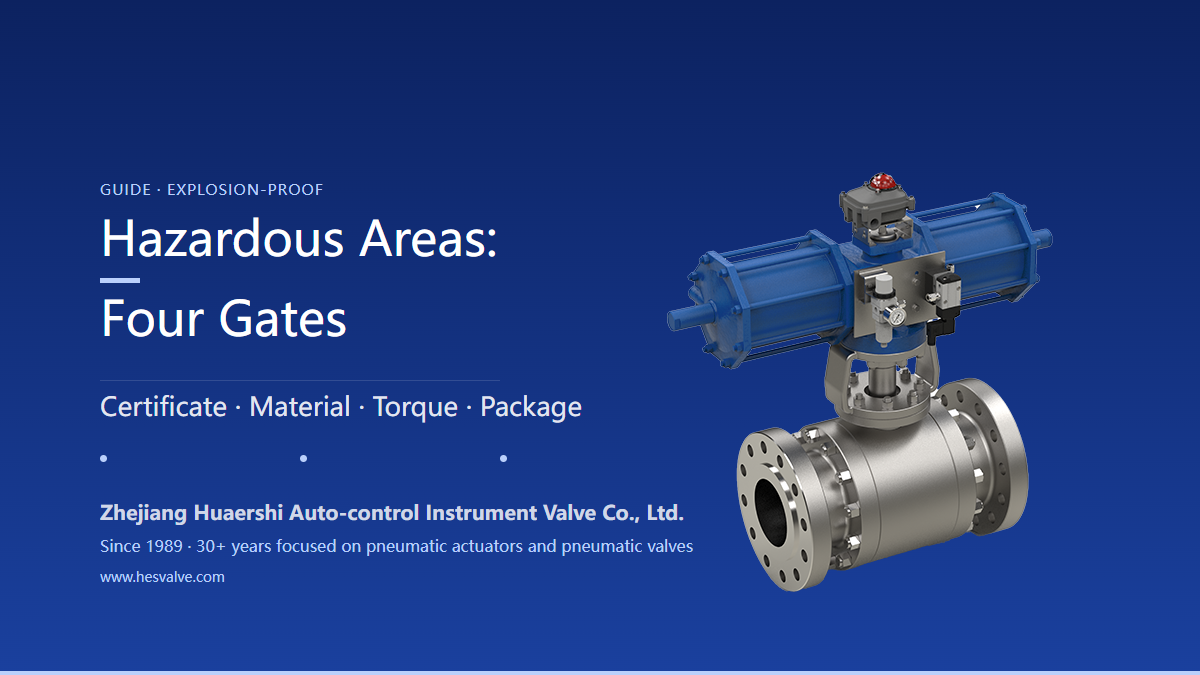
As safety regulation tightens across chemicals, oil and gas, RTO waste gas treatment and pharmaceuticals, automation projects in hazardous areas are rising fast. Buyers searching for "how to choose an explosion-proof actuator" or "reputable actuator maker" face a confusing spread of parameters and quotes: vague explosion-proof markings, inflated torque figures, and units that will not travel once installed. In a hazardous area, the wrong equipment means frequent shutdowns at best and a safety hazard at worst.
So what decides the choice? Four gates: certification, material and process, torque matching, and package with service. Three checks that are most often missed come at the end.
1. Verify Certification: It Must Be Traceable and Match
Explosion-proof actuators involve sealing structure, electrical interfaces and surface treatment. A verbal "explosion-proof" claim without authoritative certification carries very high risk.
-
Check certificates: a reputable maker provides ISO9001 quality management, CE and SIL functional safety certification. HES holds eight authoritative certifications, including ISO9001 and the special equipment manufacturing licence, all available for direct verification - check them item by item
-
Check technical depth: explosion-proof products demand real design and process discipline, and contract-assembly workshops struggle to hold consistency. HES holds more than 20 national patents, is a national high-tech enterprise and technology-based SME, and has iterated from the first QGH through AT / AW / HG
-
Check pre-dispatch inspection: air-tightness directly affects site safety. Raw material intake, precision machining, assembly and final testing are all in-house; every unit is fully tested for air-tightness, torque and life before dispatch, with a reject rate below 2%
2. Examine the Material: Corrosion and Wear Decide Service Life
Hazardous sites usually combine corrosive media, temperature extremes and dust. Poor material means seals age and action fails before long - the root cause of frequent repairs on many projects.
-
Cylinder process: a hard-anodized aluminium alloy process for wear and corrosion resistance, with service life above ordinary domestic products and hundreds of thousands of cycles under normal duty
-
Seal material: for corrosive and temperature-extreme duty, seal material can be specified to the site, preventing early ageing and leakage and removing a failure point from the hazardous area
-
Protection treatment: protection class and surface coating adjusted to the site's zone classification and outdoor conditions, and verified in salt-spray and other laboratories
3. Calibrate Torque: The Margin Is What Makes It Seat
Torque is where hazardous-area projects most often go wrong. Inflated ratings leave output short and the valve unseated - on emergency shut-off, the consequences do not bear thinking about.
-
Coverage: 8-6000 N·m for DN15-DN800; rack-and-pinion for standard on/off and angle adjustment, high-torque scotch yoke for high differential pressure and large-bore heavy duty
-
Calculate the margin: derive required torque from media pressure, valve type and actual differential pressure, and keep a margin (30-50% is typical) - never select at the limit. Free duty assessment and selection support help avoid undersized torque and misjudged explosion-proof class
-
Verify by measurement: every actuator is torque-tested before dispatch, so the figure is real; whether high-cycle switching in a hazardous workshop or emergency shut-off on a line, it performs on arrival and commissions in one pass
4. Complete the Package: Integrated Accessories Cut Commissioning Risk
The other common pain in hazardous areas: actuator, valve and accessories from different makers - poor matching, interfaces that do not align, commissioning faults, and no clear owner when something goes wrong.
-
One source: alongside its own actuators, HES supplies solenoid valves, limit switches and air filter regulators, and builds pneumatic ball, butterfly and control valves - actuator, valve and accessories from one supplier
-
Lead time and cost: imported explosion-proof equipment is expensive and slow and often delays the project; standard models ship in 7-15 days, and customers replacing imports with a domestic package have seen the supply lead time halved at around 40% of the imported cost
-
Service: on-site technical guidance, troubleshooting and fast spare parts, cutting maintenance cost and downtime
5. In Practice: An RTO Hazardous-Area Project
In a chemical RTO waste gas treatment project the workshop is a hazardous area, and media control on the exhaust line carries high safety requirements. The HES route was: confirm explosion-proof requirements → calculate torque → supply the control accessories, in one pass; after commissioning the on/off action has been reliable and the exhaust line runs safely.
The same approach applies to oil and gas, metallurgy, power and pharmaceuticals - any piping automation handling flammable or explosive media can use these four gates.
6. Three Checks Most Often Missed
Not in the original text, but the three points that come up most in review and acceptance:
-
The certificate's explosion-proof marking must match the site: "explosion-proof" as a word is not enough - check that the protection type, gas group, temperature class and zone classification match the media and rating on site
-
Accessories must be explosion-proof too: if the solenoid valve or limit switch sits in a hazardous area it must be certified the same way; an explosion-proof actuator with ordinary accessories leaves an open point in the loop
-
Emergency shut-off needs single-acting: spring return brings the valve to its safe position on air or power failure; a double-acting unit simply stays where it is - that is not a performance issue, it is a safety issue
Conclusion
Complete certification, sound material, accurate torque and a one-source package - these four gates reflect more than thirty years of actuator manufacturing at HES.
If you are selecting equipment for a hazardous-area project, or need batch customization, send us the media, pressure and temperature class and explosion-proof requirements: free duty assessment and selection proposal, product samples and explosion-proof selection data on request, and visits to the Wenzhou and Shanghai production bases can be arranged.
Zhejiang Huaershi Auto-control Instrument Valve Co., Ltd.
Since 1989 · 30+ years focused on pneumatic actuators and pneumatic valves
Website: