






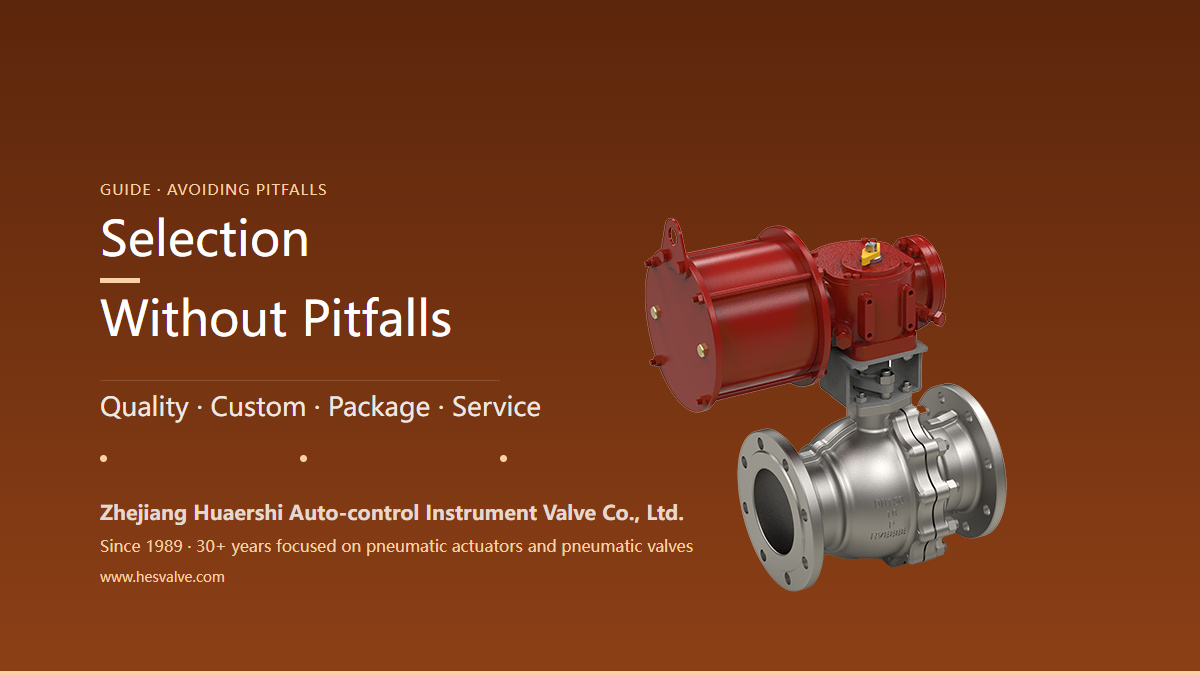
Pneumatic actuators are core components of industrial pipeline automation. As automation upgrades accelerate in chemicals, water treatment, oil and gas, and power, demand continues to climb, but many engineers encounter the same problems during procurement: searching online for "pneumatic actuator manufacturers" or "manufacturing enterprise factories" returns a mix of unreliable information, and the selected equipment either has insufficient torque and fails to open or close fully, or does not match the operating conditions and fails frequently, with later maintenance costs far exceeding expectations.
Improper selection is the primary cause of high failure rates. Misjudging medium corrosiveness, inaccurately estimating pressure and temperature ratings, and overlooking explosion-proof requirements—these seemingly minor issues often determine whether equipment can operate stably over the long term. Avoiding pitfalls is not a matter of luck; it depends on a reusable sequence of judgment.
1. First recognize: the three most common selection errors
-
Misjudging medium corrosiveness: Selecting materials only by medium name ("water," "exhaust gas") without carefully checking concentration, temperature, and impurities, so seals age and leak within six months
-
Inaccurately estimating pressure and temperature ratings: Selecting by normal operating pressure without accounting for water hammer, pressure differential, and temperature peaks, so torque becomes insufficient under extreme conditions
-
Explosion-proof requirements ignored: The workshop designated an explosion-proof area, but only the actuator was made explosion-proof while ordinary components were used for accessories, leaving openings in the circuit
What these three points have in common istreating selection as choosing a model number. What really needs to be done is translating operating conditions into parameters.
II. Step One: Look at Manufacturing Strength, Not Just Catalogs
The first hurdle in selection is determining whether the manufacturer has genuine manufacturing and testing capabilities. Inflated specifications and insufficient torque often stem from lax control in the production process.
-
Whether the testing system is complete: Equipped with professional laboratories for salt spray, life, and torque testing, with each unit completingfull-item testing rather than sampling before leaving the factory—this is the only way to eliminate false specifications
-
Whether the materials and workmanship are truly robust: the cylinder useshard-anodized aluminum alloy process, wear-resistant and corrosion-resistant; under the same working conditions, the overall service life is better than ordinary domestic products, and under normal working conditions it can achievehundreds of thousands of cycles
-
Whether certifications are complete: ISO9001, occupational health and safety, and environmental management systems; some products have obtained SIL, CE, totaling 8 authoritative certifications
-
Is production self-owned: Two major bases in Wenzhou and Shanghai, with everything from raw material intake, precision machining, assembly and commissioning to finished-product airtightness, torque, and life testing completed in-house; multiple inspections before each unit leaves the factory,with a repair rate below 2%
Step 3, Step 2: Complex working conditions must be customized; do not force-fit standard models
The root cause of many failures is that standard models are force-fitted to special working conditions. High temperature, high pressure, severe corrosion, explosion protection, and emergency shutdown all require targeted adaptation, rather than simply ordering by nominal size.
Huaersi's technical research and development originated in 1989. Founder Ji Zhongyong has been deeply engaged in the pneumatic fluid control field for more than 30 years, from the first generation of QGH to GT iterations, then to AT, AW, HG multiple generations of optimization, accumulating more than 20 national patents, and was recognized as a National High-Tech Enterprise and a Technology-Based SME.
Customization capabilities across three dimensions:
-
Material customization: adjust valve body and sealing materials according to medium corrosiveness, solving the problem of sealing parts aging easily in chemical and waste gas treatment scenarios
-
Parameter customization: Match output torque and protection rating according to pressure-temperature rating and installation space; torque 8–6000 N·m, compatible with DN15–DN800
-
Structural customization: rack-and-pinion, high-torque scotch yoke, as well as linear stroke, stainless steel and other series—select according to opening/closing frequency and torque requirements, avoid "a small horse pulling a big cart" or "using a sledgehammer to crack a nut"
IV. Step 3: One-stop matching, eliminating the patchwork of multiple manufacturers
Actuators and valves coming from different manufacturers is a common cause of frequent on-site commissioning failures: mismatched interface dimensions, incompatible signals, unclear lines of responsibility, and mutual buck-passing when problems arise—ultimately delaying project progress.
One-stop supply delivers threefold assurance:
-
High compatibility: Actuators and valves are developed and manufactured in-house as an integrated system, resolving compatibility issues at the design source
-
Convenient selection:100 multiple series and models, enabling complete control system procurement through a single channel without repeatedly comparing multiple suppliers
-
Clear accountability: The entire equipment set comes from the same manufacturer, leaving no room for finger-pointing when issues arise and ensuring direct after-sales response
V. Step Four: Full-process service, building selection into the process ahead of delivery
Many suppliers only sell products and lack application-based selection guidance, so customers can easily pay a high price for selection mistakes.
-
Pre-sales: Free application assessment and selection, with recommendations based on media characteristics, pressure and temperature, and explosion-proof requirements, to avoid selection errors
-
Delivery: Standard models 7–15 daysfor delivery; customized models are scheduled on demand; procurement cost is approximately 40%
-
After-sales: On-site technical guidance, troubleshooting, and rapid spare parts supply
Case: Municipal wastewater treatment plant — pneumatic butterfly valves and actuators supplied as complete sets for sedimentation tanks and chemical dosing lines, helping the customer reduce later maintenance costs by approximately 30%; chemical RTO exhaust gas treatment— explosion-proof pneumatic ball valves and actuators suited to explosion-proof workshop conditions; plate and metallurgy plant — high-torque scotch-yoke actuators replacing imported units, cutting the supply lead time in half.
VI. Conclusion: Selection Priorities Differ Completely Across Industries
-
Chemical and exhaust gas treatment: Focus on corrosion resistance and explosion-proof rating; stainless steel series or customized sealing materials are recommended, along with explosion-proof accessories
-
Municipal water treatment: The medium is mainly water, but considerthe corrosiveness of chemical dosing lines; purchasing pneumatic butterfly valves and actuators as a complete set is the mainstream solution
-
Oil & gas and metallurgy: Large diameters and high torque requirements; large-torque scotch-yoke actuators are more reliable
-
Pharmaceutical and semiconductor: High cleanliness and control precision requirements; the medium and hygiene rating must be clarified at the selection stage
Closing on the four key factors: Regardless of the industry, before purchasing, sort out medium characteristics, pressure and temperature range, opening and closing frequency, explosion-proof and protection requirements these four points clearly and hand them to the manufacturer for working condition assessment—this action can minimize the probability of selection errors.
Conclusion
Pneumatic actuator selection is not a simple model comparison, but a comprehensive consideration ofworking conditions, quality, supporting equipment, and service. More than 30 years of technical accumulation, two major production bases, over 100 series and models, and 8 authoritative certifications are the foundation that makes Hualshi solid in "selection"; products are exported to more than ten countries including Russia, the Middle East, and Southeast Asia.
If you are hesitating about selection, or the on-site working conditions are complex and you are worried about procurement pitfalls, send the four elements over—you can obtain a free working condition assessment and selection plan, and you can also request product technical materials and industry application cases.
Zhejiang Huaershi Automatic Control Instrument Valve Co., Ltd.
Founded in 1989 · Focused on pneumatic actuators and pneumatic valves for more than 30 years
Official website: