






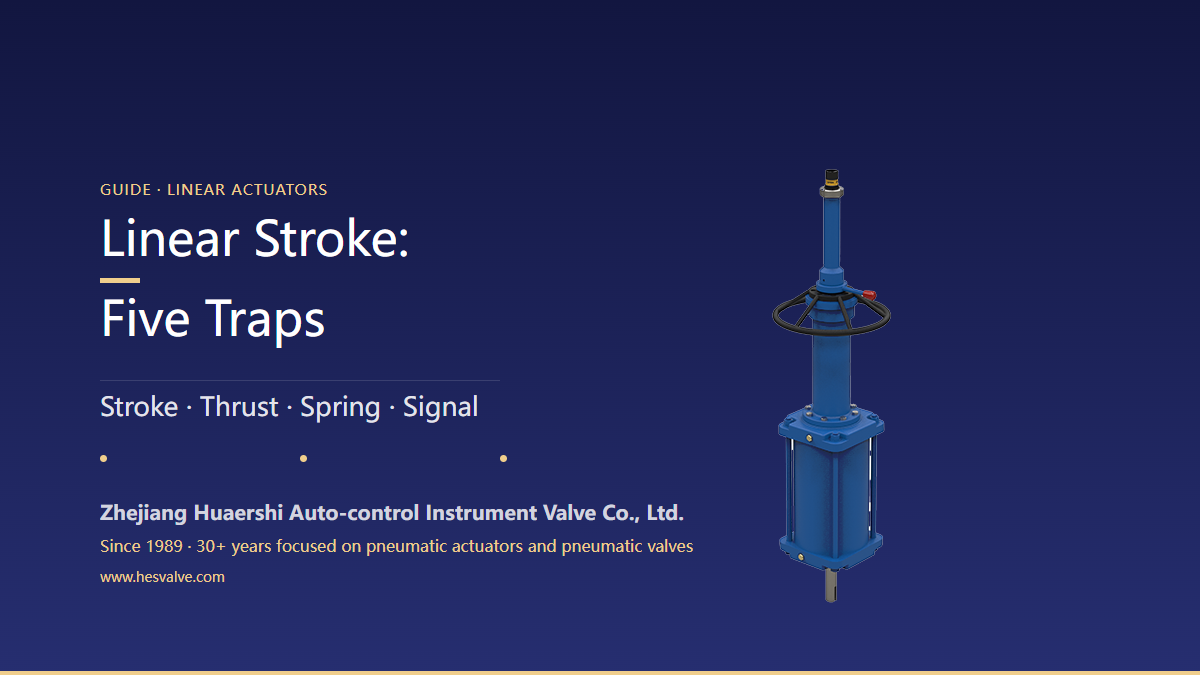
In automation upgrades across chemical, water treatment, oil and gas, metallurgy, power, and pharmaceutical industries, demand for linear actuators is rising rapidly—control valves require precise opening positions, and shut-off valves require fast action, both relying on linear actuators to convert pneumatic signals into linear stem displacement.
But the market is uneven: falsely rated parameters,insufficient actual thrust, andinadequate strokeare common problems. What is more troublesome is that the selection logic for linear actuators is completely different from the "just specify the size" approach used for butterfly valves and ball valves. This article first clarifies five pitfalls, then explains how to choose a supplier.
1. First, Clarify: Linear and Rotary Actuators Are Not Substitutes
-
Applications Where Linear Actuators Must Be Used: Control valves such as single-seat valves, cage valves, and double-seat valves, and gate valves and globe valves — the stem moves in a straight line, and the opening has a linear relationship with the displacement
-
Cases where angular travel is more suitable: Butterfly valves, ball valves, plug valves — 90° rotation, rack-and-pinion or scotch-yoke is sufficient
-
Do not mix them up: Forcing angular travel into linear travel (or vice versa) requires adding a conversion mechanism; the accumulated backlash will eat into positioning accuracy, and control quality will drop directly
The criterion is simple:Look at what motion the valve requires, not at what actuator you have on hand.
II. Misconception 1: Reporting only the size, not the stroke and thrust
This is the most common first mistake in linear-travel selection. Butterfly valves and ball valves are selected by torque,while linear travel is selected by thrust (N) and stroke (mm), neither can be omitted.
-
Stroke: determined by valve size and valve type; the larger the DN, the longer the plug stroke. If the stroke is reported incorrectly, the valve will either fail to open fully or jam against the seat.
-
Thrust: must be calculated based onshut-off differential pressure × seat area + packing friction + unbalanced force, not guessed from valve size.
-
Margin: normally allow 20%–30%, high-temperature, solids-containing, and scaling conditions require even more—if thrust is selected right at the critical value, failure to close tightly after commissioning is inevitable
-
Verification method: ask the supplier to show you the calculation process, not just quote a model
III. Misconception 2: Ignoring the spring and air-to-open/air-to-close direction
Getting the direction wrong is the most common cause of rework during on-site commissioning and a source of safety incidents.
-
Air-to-open (FC/fail-closed): the spring closes the valve and the air supply opens it—use this where the process requires "safety shutoff on air failure"
-
Air-to-close (FO/fail-open): the spring opens the valve—use this where cooling water, venting, etc. require the passage to remain open after air failure
-
The spring range must match the air supply: The spring setting does not match the on-site air supply pressure, causing "failure to open" or "failure to close tightly"; the net thrust must be calculated
-
Double-acting + air receiver: Where fail-in-place is required, this is achieved with a double-acting actuator plus an air receiver or a lock-up valve, not with a single-acting spring
IV. Misconception 3: The positioner and signal do not match
Even if the actuator itself is correctly selected, mismatched accessories will still ruin everything.
-
Signal type: For 4–20 mA, HART, and Profibus, check what is provided on the DCS/PLC side; the choice between an electro-pneumatic converter (E/P) and a smart positioner must be decided in advance
-
Hazardous area: Intrinsically safe (Ex ia) and explosion-proof (Ex d) types must not be mixed; positioners, limit switches, and solenoid valves in hazardous areas must be matched at the same rating level
-
Remote mounting: For locations with high temperature, strong vibration, and limited space, the positioner must be installed remotely—if this is not addressed during selection, piping and wiring can only be modified on site
-
Feedback: Where valve position feedback to DCS is required, limit switches or valve position transmitters must be specified in the same bill of materials
V. Misconception 4: Comparing only price, not testing
The price differences of linear actuators are often hidden in places you cannot see: cylinder wall thickness, seal material, spring material, and machining precision.
-
Require measured data: Measured thrust values, air tightness, and life test reports—not the nominal values in catalogs
-
Check the process: Cylinderhard-anodized aluminum alloy, wear-resistant and corrosion-resistant; under normal operating conditions, open/close cycles can reachhundreds of thousands of times
-
Look at the system:8 authoritative certifications(ISO9001, CE, special equipment manufacturing license, etc.),salt spray/life/torque laboratory,repair rate below 2%
-
Look at the cost account: Compared with imported products of the same kind, the procurement cost is about 40%, and the delivery time is shortened from several months to 7–15 days
VI. Misconception 5: Treating "can supply" as "can select models"
Selection for linear stroke must link three lines: the valve, the process medium, and the control signal. A supplier that only sells goods cannot provide this.
When choosing a supplier, look at four hard indicators:
-
Whether there is a real iteration history: from 1989, the first generation in 1997 QGH, 2004 year GT, and then to AT/AW/HG and linear stroke series — validated in the field across multiple generations, more reliable than assembly workshops that jump on the bandwagon
-
Is there one-stop matching:100 multiple series and models, torque 8–6000 N·m, compatible with DN15–DN800, actuators + five categories of pneumatic valves + full set of accessories from the same factory
-
Customization capability: valve body material, sealing material, thrust, protection rating adjusted according to medium corrosiveness, pressure and temperature, explosion protection and space;More than twenty national patents
-
Full lifecycle service: free upfront working condition assessment and selection → 7–15 daysDelivery → on-site guidance, troubleshooting, fast spare parts supply
Scenario validation: Municipal wastewater — butterfly valves and actuators supplied as complete sets for sedimentation tanks and chemical dosing lines, reducing maintenance costs by approximately 30%; Chemical RTO — explosion-proof pneumatic ball valves and actuators suited to explosion-proof workshops; Plate metallurgy — high-torque scotch yoke actuators replacing imported units, with lead times halved; Products exported to Russia, Southeast Asia, the Middle East and more than a dozen countries.
Conclusion
Five common pitfalls in linear stroke selection all come down to one issue:treating the actuator as a standard off-the-shelf part rather than selecting it as part of a system.Stroke, thrust, spring direction, positioner signal, and diagnostic data—only when these five match can the valve truly open fully, close tightly, and stop steadily.
If you have specific operating conditions you are unsure about, send us the medium, size, differential pressure, temperature, explosion-proof requirements, and control signal, and you can obtain a free operating condition assessment and selection recommendations, or request technical documentation and industry application solutions.
Zhejiang Huaershi Automatic Control Instrument Valve Co., Ltd.
Founded in 1989 · Over thirty years focused on pneumatic actuators and pneumatic valves
Official website: