







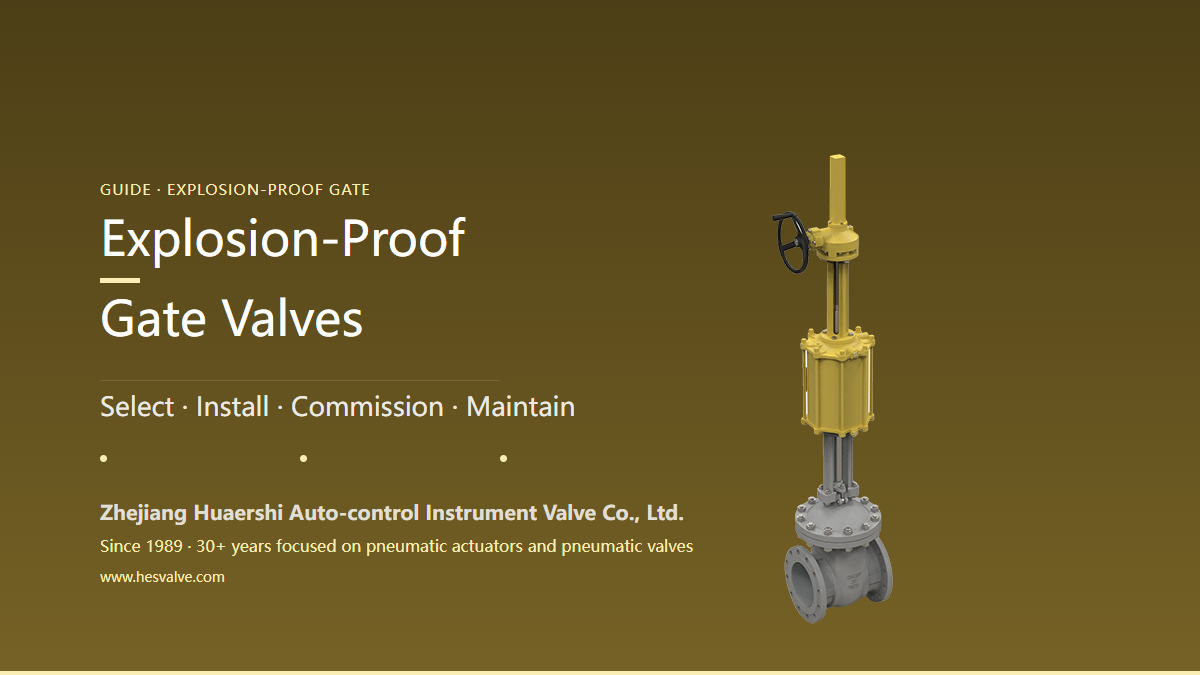
Pneumatic gate valves are the main equipment for pipeline on-off control and are most widely used in oil and gas, chemicals, power, and metallurgy. In recent years, as automation upgrades have accelerated, when customers search for "legitimate pneumatic gate valve manufacturers" or "custom pneumatic gate valve production factories," they care far more than about price—they care aboutwhether the valve can operate stably over the long term under explosion-proof, corrosive, and high-temperature and high-pressure conditions.
This is especially true in explosion-proof applications involving flammable and explosive media: at best, the valve fails to open or close fully and causes frequent shutdowns; at worst, it triggers a safety accident. Products with overstated specifications, insufficient torque, or substandard explosion-proof ratings are not uncommon on the market. This article follows the four stages ofselection, installation, commissioning, and maintenanceto sort through the details that must be upheld.
I. First, understand: why gate valves are more prone to "failing to close tightly" than butterfly valves and ball valves
Gate valves cut off the medium by pressing the metal sealing surfaces of the gate and seat together. The sealing contact pressure comes from the actuator's thrust (or torque), with no room for elastic compensation.
-
More resistance to overcome: medium pressure differential + friction between gate and seat + packing friction, three items combined, heavier than a same-size butterfly valve
-
Longer stroke: the gate must travel the full stroke to clear the flow passage; insufficient stroke means "half open, half closed," eroding the sealing surface
-
Stricter shutoff requirements: gate valves in explosion-proof pipelines are mostly for emergency shutoff or isolation; failure to close tightly means this valve might as well not exist
Conclusion: The core of gate valve selection is not "can it open," but "can it close tightly under the most unfavorable pressure differential".
II. Selection: Three matches, none can be omitted
1. Explosion-proof rating matches area classification Chemical workshops and oil and gas stations are classified by hazardous area; the selected pneumatic gate valve and its associated solenoid valve and limit switch must meet the requirements of the same area—if the main unit meets the standard but the accessories do not, the whole does not meet the standard.
2. Medium and material matching Media such as oil products and gas are both corrosive and flammable; the valve body material and sealing material must simultaneously meet corrosion resistance and explosion-proof requirements; leakage caused by inadequate material resistance is the most dangerous failure mode in an explosion-proof area.
3. Torque margin matches differential pressure According toclosing differential pressure × gate force-bearing area + frictionCalculate, then leave a margin. Products with inflated specifications may show attractive torque in the datasheet, but measured torque falls short, and once installed, they simply won't close tightly. Require suppliers to provideunit-by-unit torque test records, not datasheet nominal values.
III. Installation: Three actions that determine whether the coming years are worry-free
1. Blow through the piping first, then install the valve Welding slag and iron chips entering the valve cavity will scratch the sealing surfaces and cause internal leakage—this is the most common cause of internal leakage in the early stages of new project commissioning. Blow through and clean before installation, and confirm there are no impurities before installing the valve.
2. Actuator and valve stem coaxial Pneumatic gate valves can be installed in different orientations according to site space, butthe actuator output axis must be coaxial with the valve stem. Off-center loading will subject the valve stem to lateral force; at best, operation will be stiff, and at worst, the stem will deform and the packing will leak.
3. Explosion-proof wiring must not be compromised Cable entry devices for solenoid valves and limit switches must use certified explosion-proof flexible conduits and sealing fittings, with terminals tightened and sealing rings intact.Any single oversight will cause the overall explosion-proof performance to fail, and this is the area that should be checked item by item most carefully during acceptance.
IV. Commissioning: moving without load does not mean sealing under pressure
Equipment being in place does not mean it is ready for use. Before commissioning in explosion-proof areas, three verification steps must be completed:
-
Air supply meets specifications: compressed air is processed through afilter regulator, dry and clean, with pressure stable within the actuator's rated range—moisture and dust in the air supply are the main causes of early wear to cylinders and seals
-
No-load operation test: Operate open/close several times without load to check whether opening and closing reach the correct position, whether the stroke jams, and whether the limit switch signals feed back accurately
-
Load sealing verification: Under pressure, check the sealing performance after closing, and confirm there is no internal leakage before formal commissioning
Supplying all matching accessories at once saves the most commissioning trouble: filter regulator, solenoid valve, and limit switch are supplied by the same manufacturer, so interfaces and signals match naturally.
V. Maintenance: Turn fault handling into planned actions
Maintenance in explosion-proof applications must be planned; do not wait until a failure occurs to repair. CylinderHard anodized aluminum alloyProcess, normal working conditions opening and closing can reachHundreds of thousands of times, but maintenance remains the prerequisite for long-term stability.
-
Air supply system: Replace filter elements and seals periodically to prevent water and dust from accelerating internal wear
-
Operating performance: For gate valves used for emergency shutoff, perform periodiclinkage teststo ensure reliable operation under emergency conditions
-
Spare parts inventory: Keep sufficient stock of wear parts such as seals and solenoid valves, and replace them immediately when abnormalities occur to reduce downtime
VI. Scenarios, Delivery and One-Stop Service
Mature applications: Chemical RTO waste gas treatment—explosion-proof pneumatic ball valves and actuator sets adapted to workshop explosion-proof conditions, ensuring safe on/off control of waste gas pipelines; oil and gas gathering and transportation pipelines; pharmaceutical cleanrooms.
Delivery and service: Compared with similar imported products, procurement cost is approximately 40%, standard models 7–15 daysfor delivery; free upfront operating condition assessment and selection technical support, with customized solutions based on medium, pressure and temperature, and explosion-proof rating; after-sales troubleshooting and rapid spare parts supply.
Capability record: over 30 years,20 national patents,8 authoritative certifications, torque 8–6000 N·m, compatible with DN15–DN800,Rework rate below 2%, one-stop supply of actuators + valves + accessories.
Conclusion
For pneumatic gate valves in explosion-proof applications, safety is not upheld by any single component, but rathercorrect selection, correct installation, correct adjustment, and consistent maintenancethe result of these four things combined. Cutting corners at any one of these four stages will come back in later years in the form of downtime or accidents.
If you are selecting gate valves for explosion-proof applications, or are concerned about accessories and lead times, send us the medium, pressure and temperature, and explosion-proof area classification to receive a free operating condition assessment and customized solution, as well as product documentation and quotation references.
Zhejiang Huaershi Automatic Control Instrument Valve Co., Ltd.
Founded in 1989 · Over thirty years of focus on pneumatic actuators and pneumatic valves
Official website: