







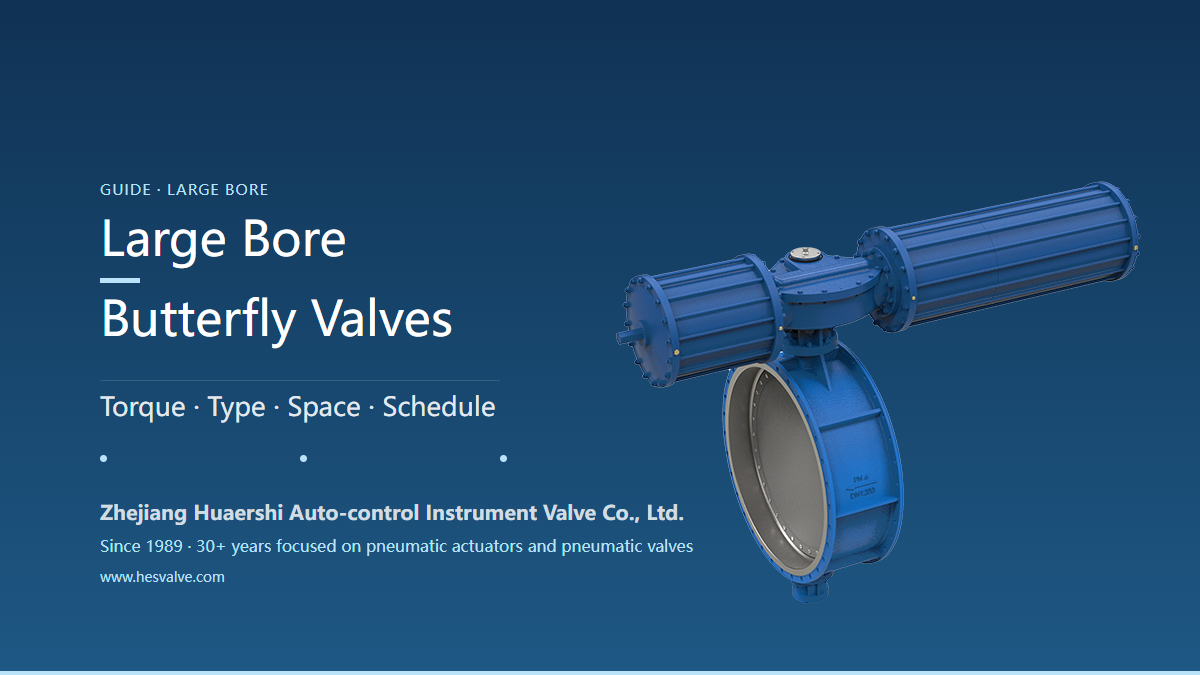
Pneumatic butterfly valves are the most "universal" type of equipment in pipeline fluid control, butonce the diameter gets large or the application is an existing line, sizing becomes a completely different matter. Above DN300, torque rises rapidly with diameter and differential pressure, so the actuator type, air supply capacity, and installation space all need to be recalculated; retrofit projects on old lines also face practical issues such as out-of-round piping, cramped space, and the inability to shut down for long periods.
This article does not discuss generic "four major advantages," but only how to configurelarge diameter and retrofit projects: torque, structure, space, and schedule.
1. Why Large Diameters Are Hard to Configure: Torque Does Not Increase Linearly
-
Torque scales up with diameter: The disc area grows with the square of the diameter, and at constant differential pressure the required torque also grows approximately with the square—the torque of DN500 may be more than six times that of DN200
-
Eccentricity and bearing loads: The larger the bore, the greater the bending moment on the stem from the disc's own weight and the medium's thrust, and the lateral loads on the bearings and packing rise accordingly
-
Hydrodynamic torque: The dynamic torque produced by the medium flow impacting the disc, most pronounced during fast opening and closing and pump start/stop; sizing must include a margin
-
Conclusion: Large bores cannot be linearly extrapolated from the catalog values for small bores;each unit must be calculated individually based on the actual differential pressure
2. Structural selection: large bores favor scotch-yoke designs
Rack-and-pinion vs scotch-yoke; the difference lies in the shape of the torque curve:
-
Rack-and-pinion: Smooth torque output, compact structure and small size, suitable for small and medium bore sizes and high switching frequency applications
-
Scotch yoke: Delivers greater torque at both ends of 0° and 90°, precisely covering the two positions where resistance is highest during butterfly valve opening and closing—For large bore sizes and high pressure differentials, choose this one first
-
Double-acting vs single-acting: For fail-position holding, use double-acting plus an air receiver; for fail-close/fail-open, use single-acting spring return, but verify whether the spring can complete the action under the full pressure differential
-
Air supply capacity: Large-bore double-acting actuators consume a large amount of air; the air supply pipe diameter, air receiver volume and solenoid valve flow rate must all be scaled up accordingly. Replacing only the actuator without upgrading the air supply will noticeably slow the action
3. Body styles: wafer and double-flanged, the difference lies in installation and removal
-
Wafer type: short face-to-face dimension, light weight, low cost; it is the conventional choice for medium- and low-pressure ambient-temperature pipelines; however,installation and removal require displacement space in the piping on both sides, which is especially difficult for large diameters
-
Double-flanged (flanged connection): comes with its own flanges and can be bolted directly to the pipeline;installation and removal do not require pipe displacement, suitable for large diameters, frequent maintenance, and rigid piping
-
Soft seal vs Hard seal: Soft seal (EPDM/PTFE) offers good sealing performance but has a temperature limit; hard seal is resistant to high temperatures and wear, suitable for high-temperature and solids-containing media
-
Pipeline stress: The dead weight of large-diameter valves and thermal expansion and contraction of pipelines generate additional stress at the flanges; retrofit projects in particular must recheck supports and compensation
IV. Three practical issues in retrofit projects
Old-line retrofits and new construction projects are two entirely different approaches:
-
On-site measurement of original pipeline dimensions: After years of operation, old pipelines may have out-of-round cross-sections and corroded pits on flange faces, so valves ordered from drawings often cannot be installed—diameter, flange hole spacing, and bolt specifications must be measured on site
-
Installation space: The original design may not have reserved height for the actuator or space for maintenance; large-diameter actuators are bulky,Measure the clearance first, then decide the structural form
-
Cannot afford long downtime: Pre-assemble the complete valve and actuator assembly, switch in sections during low-load periods, or add bypass piping to minimize downtime
Confirm these three things before ordering, which saves far more than making changes on site.
V. Integrated matching: why it is recommended to order the complete set together
The compatibility issues of large-diameter butterfly valves are concentrated in three interfaces:shaft-to-bore connection dimensions, torque and valve stem strength, and air circuit matching between accessories and actuator.
-
Produced in-house by the same factory: Integrated development and production of actuator and valve body, connection dimensions and torque naturally match, avoiding rework when "the actuator arrives but won't fit the valve"
-
Complete accessory set: Solenoid valves, limit switches, and filter regulators supplied by the same factory,air circuit flow and connections configured in one go— commissioning time on large-diameter projects is mostly spent on accessories
-
Single point of responsibility: The whole set comes from one supplier, so if problems arise there is no passing the blame between multiple parties
VI. Quality, Delivery, and Applications
Quality track record: Full in-house manufacturing process (raw materials → precision machining → assembly and commissioning → airtightness, torque, and life testing),8 authoritative certifications, salt spray/life/torque laboratory,rework rate below 2%.
Performance and delivery:AT/AW/HG multiple generations of iteration,8–6000 N·m, compatible with DN15–DN800, normal-condition opening and closinghundreds of thousands of cycles; standard models 7–15 days, custom production scheduled on demand; compared with equivalent imported products, procurement cost is about 40%.
Application validation: municipal wastewater—butterfly valves and actuators supplied as complete sets for sedimentation tanks and chemical dosing lines, reducing maintenance costs by about 30%; chemical RTO— explosion-proof pneumatic ball valves and actuators; plate metallurgy retrofit — high-torque scotch-yoke alternative to imports, halving lead times; products exported to Russia, Southeast Asia, the Middle East and more than a dozen countries.
Conclusion
The essence of large-diameter butterfly valve selection is to take Torque, structure, space, and scheduleThese four things should be calculated clearly before ordering. Once they are clear, even retrofit projects can be implemented smoothly; if they are not clear, even the best product will get stuck on site.
If you are dealing with working conditions of DN300 or above, or an old line retrofit, send over the nominal size, differential pressure, medium, temperature, installation space, and shutdown window to obtain a free working condition assessment and complete selection solution.
Zhejiang Huaershi Automatic Control Instrument Valve Co., Ltd.
Founded in 1989 · Over thirty years of focus on pneumatic actuators and pneumatic valves
Official website: