







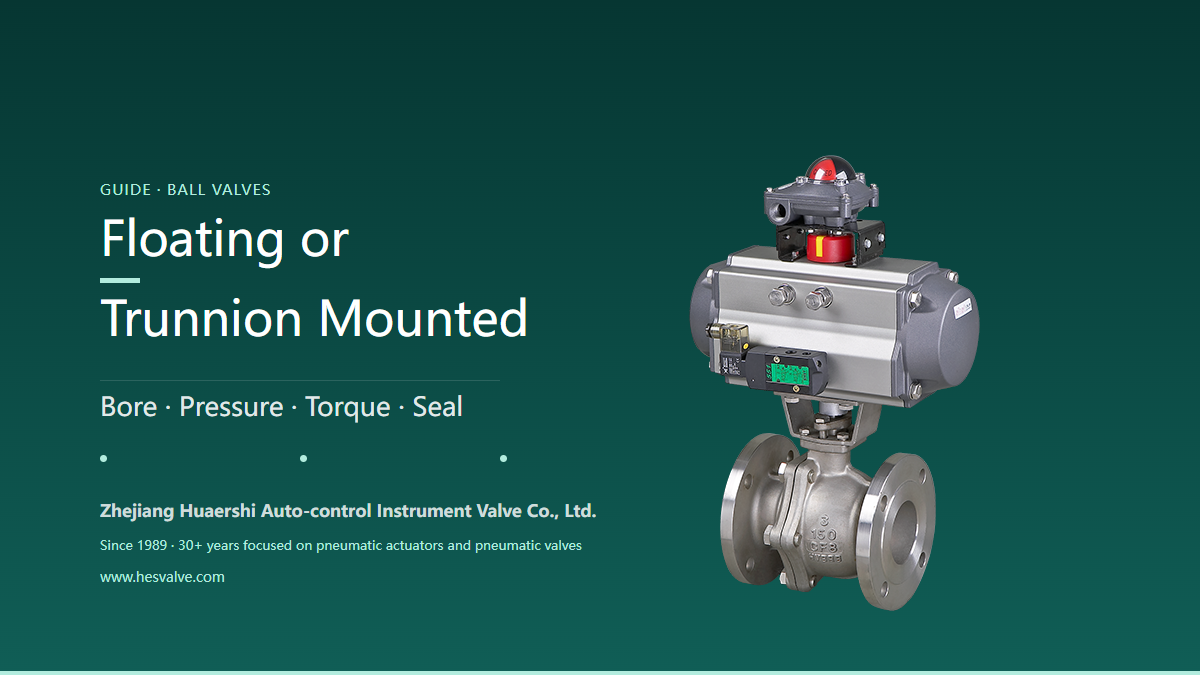
Pneumatic ball valves are the most reliable type for on-off isolation in pipelines, but what really determines whether they work well is not the words "ball valve"—it ishow the ball is supported and how the seal is established—that is, the distinction between floating ball and trunnion ball.
The two differ little at small sizes and low differential pressure, but once you go above DN200, or when the differential pressure is high or the medium is dirty, choosing wrong means stiff operation, erosion of the sealing surfaces, and ever-larger actuators. This article explains four points clearly: structure, torque, sealing, and actuator sizing.
1. Structural Difference: Who Moves, Who Presses
Floating Ball (Floating Ball) The ball is held between two seat rings,with no upper or lower support shaftThe medium pressure pushes the ball toward the seat on the outlet side; the higher the pressure, the greater the sealing specific pressure—this is its self-sealing principle.
Trunnion ball (Trunnion Mounted) The ball is fixed in the valve body by two shafts (trunnions) at the top and bottom,the ball does not float. Sealing relies on the seat being pressed against the ball surface under medium pressure and spring force, forming a piston-type seal.
To distinguish in one sentence:A floating ball relies on "differential pressure pressing the ball onto the seat," while a trunnion ball relies on "the seat being pressed onto the ball."
II. Torque: This is the most substantive difference between the two
-
Floating ball: The ball is clamped by the seats, and the sealing specific pressure rises with the differential pressure,Torque increases rapidly with bore size and differential pressure. DN200 and above, under high differential pressure conditions, torque can reach astonishingly high levels
-
Trunnion ball: the ball is supported by a shaft, seat sealing force is controllable,torque is low and stable, and does not vary drastically with differential pressure
-
Measured impact: at the same DN300, 1.6 MPa differential pressure, trunnion ball torque may be only one-third to one-half that of a floating ball
-
Selection implication: it is not a matter of "fitting a larger actuator to solve it"—when the actuator is enlarged, the forces on the stem, ball, and seat increase simultaneously, making damage more likely
Conclusion: above DN200, high pressure differential, frequent operation—prefer trunnion-mounted ball; below DN150, medium and low pressure—floating ball is more economical.
3. Sealing: unidirectional vs. bidirectional—the difference lies in process safety
-
Floating ball: primarily unidirectional sealing; sealing performance depends on the direction of pressure differential; bidirectional sealing requires a special structure (double-piston seat)
-
Trunnion-mounted ball: inherently supportsbidirectional sealing, and can achieve DBB (double block and bleed)—the cavity can be depressurized, a standard requirement for oil and gas, chemical loading, and metering pipelines
-
Soft-seated vs metal-seated: PTFE/RPTFE offer good sealing with a temperature limit; metal seating withstands high temperatures and wear, suitable for steam and media containing solids
-
Fire safety and anti-static: For oil and gas applications, confirm the fire-safe design (fire-safe) and static discharge design
4. How to select the actuator: don't just go by valve size
-
Select by torque, not by valve size: First obtain theactual torquefrom the valve manufacturer (including the safety factor), then select the actuator model, and finally verify whether the air supply can drive it
-
Floating ball: High torque with large fluctuations; mostly use high-torque scotch-yoke (HG series) or step up one size of rack-and-pinion
-
Trunnion ball: Low and stable torque; can select one size smaller, for faster action and less air consumption
-
Air-to-open / air-to-close: For processes requiring shutoff on air failure, use air-to-open (FC); for maintaining a flow path on air failure, use air-to-close (FO); for fail-in-place on air failure, use double-acting plus an air receiver
-
Accessories: Ball valves are mostly for on/off service; a solenoid valve plus limit switches is the basic configuration; if valve position feedback to DCS is required, add a valve position transmitter
V. Four common mismatches
-
DN250 using a floating ball to handle 2.5 MPa pressure differential: Even with a very large actuator, opening and closing remain difficult; long-term high specific pressure on the sealing surface accelerates wear
-
Small-diameter, strong top-entry fixed ball: cost doubles, benefit is minimal
-
Looking only at catalog torque and not actual differential pressure: catalog torque is often rated for room-temperature clean water and one-way differential pressure, which differs from actual operating conditions
-
Ignoring solids in the medium: a medium containing solids can get stuck between the ball and the seat, causing rapid failure of the soft seal; switch to a hard seal or change the valve type
Six, selection checklist and supporting capabilities
Provide the six items to the manufacturer before ordering: size, medium (whether it contains solids), maximum differential pressure, temperature, connection standard, actuation mode (air-to-open / air-to-close / double-acting).
Huaersi's supporting:
-
Structural coverage: rack-and-pinion (AT/AW), high-torque fork type (HG), linear stroke and stainless steel series, torque 8–6000 N·m, compatible with DN15–DN800
-
Complete set capability: ball valves, butterfly valves, gate valves, control valves, shut-off valves and solenoid valves, limit switches, filter regulators available in one stop
-
Quality: full in-house manufacturing, 8 authoritative certifications, salt spray/life/torque laboratory, repair rate below 2%
-
Delivery: standard models 7–15 days, custom orders scheduled on demand; compared with equivalent imported products, procurement cost is about 40%
Applications: municipal wastewater (butterfly valve and actuator sets, maintenance cost reduced by about 30%), chemical RTO (explosion-proof ball valves and actuators), plate metallurgy (high-torque scotch yoke actuators replacing imports, lead time halved), and exports to Russia, Southeast Asia and more than ten other countries.
Conclusion
Floating ball and trunnion ball designs are not a case of "the more expensive, the better"; rather,size, pressure differential and operating frequency together determine which one to use. Choose correctly, and the actuator can be one size smaller, act faster and last longer; choose wrongly, and even a larger actuator is merely shouldering the pressure on behalf of the structure.
If you have specific sizes and differential pressures on hand, send them over to get free torque calculation and selection advice.
Zhejiang Hualishi Automatic Control Instrument Valve Co., Ltd.
Founded in 1989 · Over thirty years of focus on pneumatic actuators and pneumatic valves
Official website: