








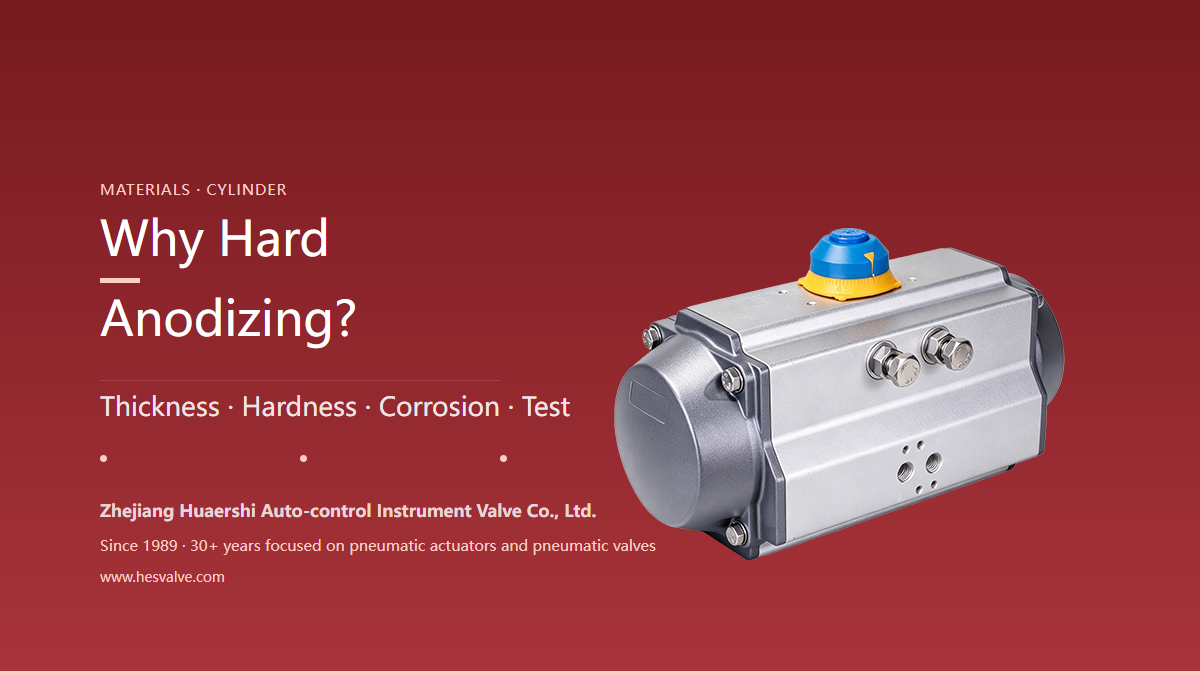
Pneumatic actuator failures are rarely a "sudden breakdown"; most follow a slow chain:cylinder bore wear → uneven force on seals → internal leakage → output torque decay → incomplete valve opening/closing. By the time incomplete closure is noticed on site, hundreds of thousands of cycles have often already passed.
The chain starts at the cylinder bore. That is why mid- to high-end actuators generally usehard-anodized aluminum alloycylinders. This article explains the process thoroughly: how the coating forms, its three practical benefits, where its limits lie, and how to inspect it at acceptance.
1. The cylinder is the actuator component most prone to "degradation"
-
The most demanding operating conditions: The piston reciprocates at high frequency inside the cylinder, the seal is always rubbing against the inner wall, and there are pressure and temperature fluctuations from the compressed air
-
Failure is gradual: scoring of the inner wall → uneven local stress on the seal → increased internal leakage → reduced thrust at the same air pressure → slower valve action and incomplete closing
-
High repair cost: once grooves are worn into the cylinder barrel, replacing the seal does not solve it; only the barrel or the whole unit can be replaced—this is also a common source of "high rework rate"
-
Judgment: cylinder craftsmanship determines the actuator'slower limit of service life, it is not an optional accessory
II. What hard anodizing is: the difference from ordinary anodizing
Both are anodizing of aluminum alloy; the difference lies infilm thickness, hardness and density:
-
Standard anodizing: film thickness is typically 5–15 μm, mainly addressing appearance and light corrosion protection
-
Hard anodizing (hard anodic oxidation): film thickness is typically 25–50 μm, with surface hardness up to HV 350–500, the film is dense with few pores
-
The key is that it "grows into the aluminum": the oxide film is converted from the base metal and bonds firmly to the substrate, unlike electroplated layers, which carry a risk of interfacial peeling
-
Sealing treatment: after anodizing, a sealing treatment is applied (boiling water or nickel salt sealing) to close the micropores, further improving corrosion resistance
In one sentence:ordinary anodizing is "surface treatment", while hard anodizing is "structural reinforcement".
III. Three practical values
1. Wear resistance: no scratching even under high-frequency reciprocation The film has high hardness, so the inner wall is not easily scratched by the reciprocating piston; combined with the dimensional accuracy and roundness of the cylinder barrel ensured by precision machining, the compression of the seal is uniform, and after long-term operationOutput torque remains stable, with no internal leakage or sluggish operation caused by cylinder wall wear.
2. Corrosion resistance: chemical, water treatment, salt spray environments Moisture, acid and alkali media, and salt spray are the normal operating environment for pneumatic components. After dense film formation and sealing treatment, the surface has almost no pores,resists pitting and peeling; combined with seal materials selected according to operating conditions (NBR/FKM/PTFE), it can serve long-term even in high-humidity and corrosive atmospheres.
3. High and low temperatures: reduced deformation and sticking Aluminum alloy has good thermal conductivity and is lightweight; after hard anodizing, thermal stability is further enhanced. Near high-temperature steam lines and in outdoor low-temperature environments, cylinder dimensions change little,reducing deformation and sticking caused by temperature differences, making remote valve opening/closing and angle adjustment more reliable.
4. The process also has limits: four pitfalls to watch for
-
The coating is somewhat brittle: Hard anodized coatings have high hardness but lower toughness than the substrate;stress concentrations at sharp corners, threads, and transitions can easily cause cracking—structural design should avoid sharp corners, and handling during assembly must prevent impacts
-
Scratches during assembly: No matter how hard the coating is, it is vulnerable to metal burrs during assembly; the chamfer at the cylinder barrel inlet and cleanliness must be controlled
-
Seals must be matched: The surface energy of the coating differs from that of standard anodizing; seal materials and grease should be selected according to the manufacturer's recommendations, as using the wrong grease will accelerate aging
-
Thicker is not always better: If the coating is too thick, it reduces fatigue strength and increases internal stress;25–50 μm is the engineering balance range
V. How to inspect on procurement: three hard indicators
-
Coating thickness: Sample-test with a coating thickness gauge against the manufacturer's stated range (e.g., ≥25 μm), rather than taking "hard anodizing was done" at face value
-
Hardness and salt spray: Request hardness test andsalt spray test reports(commonly graded at 48–500 hours); for corrosive conditions, require a higher grade
-
Whole-unit data: Cylinder bore roundness and roughness, factoryairtightness test,measured torque curve, life test records
Verification method: Require unit-by-unit inspection records rather than a generic sample; if possible, visit the factory to see the laboratory and inspection process.
VI. From process to delivery: how this capability is implemented
Manufacturing and inspection: Two major production bases in Wenzhou and Shanghai, a full set of CNC machining equipment, equipped withSalt spray, life, and torque laboratory; everything from raw material receiving, precision machining, assembly and commissioning to finished-product airtightness, torque, and life testing is completed in-house,with a repair rate below 2%.
Technology and certifications: since 1989, multiple generations of iteration (QGH→GT→AT/AW/HG),more than 20 national patents,8 authoritative certifications(ISO9001, CE, special equipment manufacturing license, functional safety for some SIL).
Matching and delivery: rack-and-pinion and high-torque scotch yoke, linear stroke and stainless steel series, torque 8–6000 N·m, compatible with DN15–DN800, 100 multiple models; one-stop service for actuators + five types of pneumatic valves + full set of accessories; standard 7–15 days, cost about imported 40%.
Scenarios: municipal wastewater—complete butterfly valve and actuator sets, maintenance costs reduced by about 30%; chemical RTO—explosion-proof ball valves and actuators; plate and metallurgy—high-torque scotch yoke alternatives to imported products, lead times halved; exported to Russia, Southeast Asia, the Middle East, and other regionsMore than ten countries.
Conclusion
The value of hard-anodized aluminum alloy cylinders does not lie in sounding "premium," but in how they hold backwear, corrosion, and temperature differentials—these three slow processes: torque drops slowly, so the valve stays shut, and maintenance costs stay low.
If you are selecting actuators for corrosive, high-humidity, or alternating high-and-low-temperature conditions, send us your medium, temperature, pressure differential, and actuation frequency to receive a free operating-condition assessment and selection recommendations, or request test reports and process documentation.
Zhejiang Huaershi Automatic Control Instrument Valve Co., Ltd.
Founded in 1989 · Over thirty years focused on pneumatic actuators and pneumatic valves
Official website: