








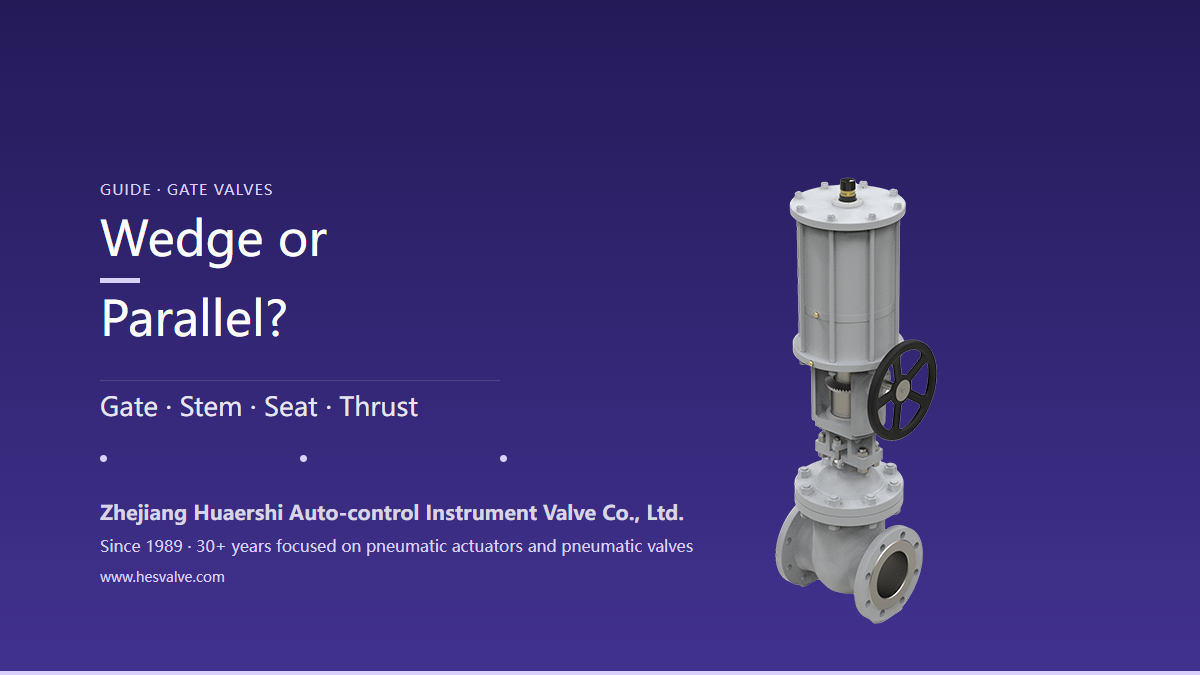
Pneumatic gate valves are the workhorses of pipeline on/off control, but in chemical, water treatment, oil and gas, and power projects, the term "gate valve" covers several structural variants:wedge vs. parallel, rising stem vs. non-rising stem, soft seal vs. metal seal. Choose the wrong structure, and even the best actuator will only make do.
Before choosing a manufacturer, clarify the structure first—this is also the first test of whether a factory truly understands gate valves. This article covers six points: application trade-offs, gate disc structure, stem form, sealing, pneumatic automation essentials, and how to vet manufacturers.
1. First, Be Clear: A Gate Valve Is Not a "Universal Shutoff Valve"
-
Suitable for: full-open or full-closed shutoff and isolation, in pipelines requiring low flow resistance and unobstructed bore—when fully open, the gate valve flow path is almost straight-through, with minimal pressure loss
-
Not suitable for: Throttling control. When the gate is half-open, the medium scours the sealing surface at high velocity; a few months of scouring can ruin a valve.
-
Trade-offs with other valves:
-
Butterfly valve — saves space and costs less, suitable for large-diameter medium- and low-pressure water systems
-
Ball valve — fast opening and closing, reliable sealing, suitable for frequent operation and quick shutoff
-
Gate valve — low pressure loss, sealing surface not easily eroded directly by the medium, suitable forlong-term fully open, occasional shutoffmain lines
-
In one sentence: a gate valve is a valve that "opens all the way and closes tight" — don't use it to regulate flow.
II. Gate structure: wedge type and parallel type
Wedge type (Wedge)
-
Rigid wedge: The gate is a one-piece wedge that seals by fitting its wedge angle against the seats; simple structure and reliable sealing; however,at high temperatures the body and gate expand differently, making sticking likely
-
Flexible wedge: The gate has elastic grooves on both sides, allowing slight deformation to compensate for thermal expansion and machining errors,more commonly used at high temperatures and in large diameters
-
Applications: Ambient to medium temperature, clean media, and applications requiring tight sealing
Parallel type (Parallel)
-
Double disc with an expanding mechanism; relies on medium pressure or mechanical expansion to press the two discs tightly against the seats
-
Advantages: does not depend on the wedge angle,and is not prone to jamming in high-temperature media, media containing solids, or media prone to scaling; slight compensation is possible after sealing surface damage
-
Trade-offs: complex structure, slightly higher cost, and sealing contact pressure depends on the condition of the expanding mechanism
How to choose: clean medium, ambient temperature → wedge type (flexible wedge);high temperature, containing solids, prone to scaling → parallel double-disc.
3. Stem: Rising stem and non-rising stem
-
Rising stem (Rising Stem): The stem rises and lowers with opening and closing,making the opening position visible at a glance, which facilitates inspection to determine valve status; the disadvantage is that it occupies space above, so clearance must be calculated for high-rise piping and indoor layouts.
-
Non-rising stem (Non-rising Stem): The stem only rotates and does not rise,with a fixed height that saves space, suitable for space-constrained or buried installations; the disadvantage is thatNo visible opening position, requiring limit switches or a valve position indicator
-
Differences after pneumatic actuation: Rising stem plus limit switches allow dual confirmation; non-rising stem relies more on limit switches and actuator stroke settings,and stroke position must be additionally verified during commissioning
IV. Sealing: soft sealing and metal sealing
-
Soft sealing(NBR/EPDM/PTFE): good sealing performance, enabling lower leakage classes; subject to a temperature limit, and solid-containing media can easily scratch the seal
-
Metal sealing: resistant to high temperature, wear and erosion, suitable for steam, high-temperature flue gas and solid-containing media; however, it requires a higher sealing specific pressure,Higher thrust requirements for the actuator
-
The three real causes of "not closing tightly": the sealing surface is scratched by welding slag or the medium,the stroke is not completed(the gate does not seat on the valve seat), insufficient thrust—check these three items first before discussing valve replacement
V. Three key points after pneumatic conversion
-
Thrust/torque calculation: A gate valve presses the gate tightly against the seat by thrust, and the calculation must be based onmaximum differential pressure + packing friction + seat reaction force, with a 20–30% margin; for large-diameter gate valves in particular, do not size by diameter alone
-
Stroke and limit: Insufficient stroke means "half-open, half-closed," which scours the sealing surface; over-travel will jam the seat —limits must be set after on-site measurement
-
Air-to-open / air-to-close: Use air-to-open (FC) where the valve must close on air failure, and air-to-close (FO) where the passage must remain open on air failure; if fail-in-place is required, use double-acting plus an air receiver
Six, how to verify a manufacturer: four hard criteria
-
Integrated in-house development and production: The actuator and valve body come from the same factory, so interface dimensions, thrust and stem strength match inherently, avoiding "the actuator arrives but won't fit the valve"
-
Full-process testing: Raw materials → precision machining → assembly and commissioning →Airtightness, torque, and service life testingAll performed in-house; per-unit records required
-
Certifications and data:8 authoritative certifications(ISO9001, CE, special equipment manufacturing license, some SIL);Repair rate below 2%, normal operating conditions open/closehundreds of thousands of cycles
-
Delivery and service: Standard models 7–15 days, cost approximately imported 40%; free upfront operating-condition assessment, after-sales troubleshooting and fast spare-parts supply
capability inventory: since 1989, multiple generations of iteration (QGH→GT→AT/AW/HG),more than 20 national patents, torque 8–6000 N·m, compatible with DN15–DN800, 100 multiple models, two major production bases.
Applications: municipal wastewater—sedimentation tanks and chemical dosing lines, maintenance costs reduced by approximately 30%; chemical RTO——Explosion-proof ball valves and actuators suit explosion-proof workshops; plate metallurgy——high-torque scotch yoke replaces imports,lead time halved; exported to Russia, Southeast Asia, the Middle East and more thana dozen countries.
Conclusion
Selecting a pneumatic gate valve essentially comes down to two judgments:whether the structure is right (wedge/parallel, rising/non-rising stem, soft/metal seal)andwhether the thrust is sufficient (calculated from the pressure differential, not guessed from the nominal size). Once these two things are settled, what remains is comparing price and lead time.
If you have specific media, differential pressure and nominal size, send them over to get a free thrust calculation and structural recommendation.
Zhejiang Huaershi Automatic Control Instrument Valve Co., Ltd.
Founded in 1989 · Over thirty years focused on pneumatic actuators and pneumatic valves
Official website: