








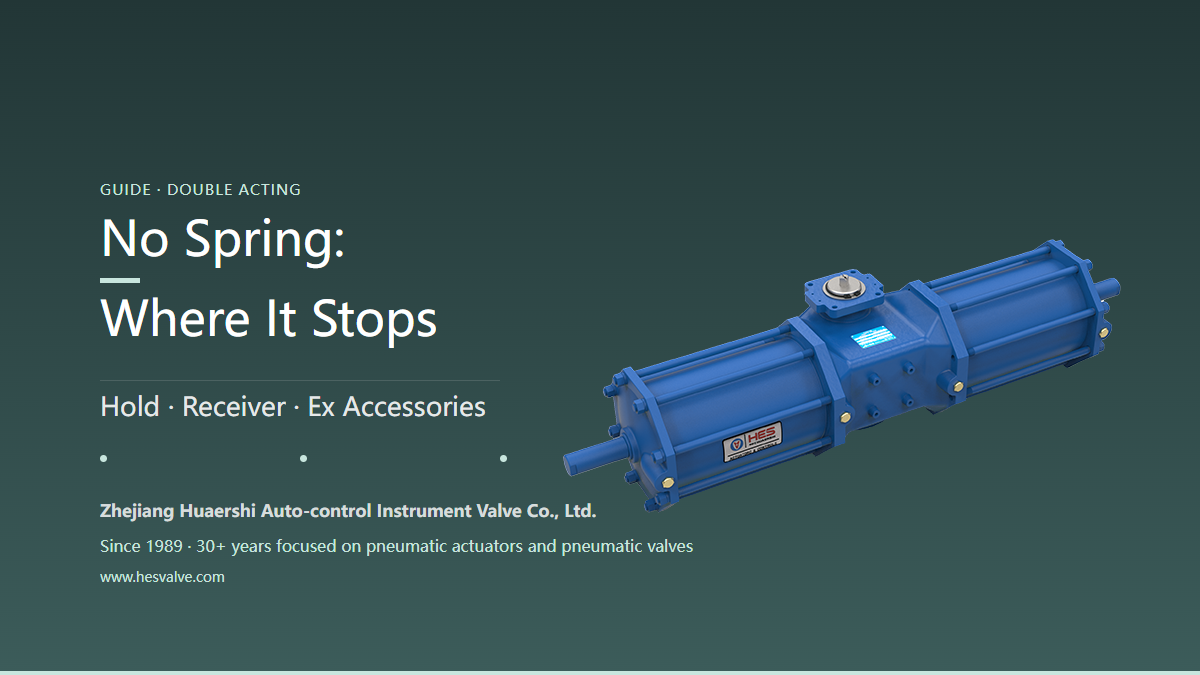
When selecting double-acting actuators for explosion-proof chemical applications, procurement usually focuses on three things: whether the torque is sufficient, whether the explosion-proof rating is correct, and whether delivery is fast. But what truly determines project acceptance and the consequences of an accident is often a question that gets skipped—after air loss, where does the valve stop?
Double-acting actuatorshave no spring, so on air loss they stay in place. This is both their advantage (no unintended movement) and their biggest risk (failing to close when they should). This article explains the "fail position" issue thoroughly, then covers the other four aspects of explosion-proof selection.
1. The double-acting structure determines: air loss = stay in place
-
Double-acting (DA): both air chambers must be supplied with air; one side admits air while the other exhausts for movement to occur;When the air supply is lost, pressure on both sides of the piston is released simultaneously, and the valve stops at its current position
-
Single-acting (SR): one side relies on a spring; when air is lost, the spring pushes the valve to a preset position (closed or open)
-
This means: for double-acting to achieve "fail-closed" or "fail-open", it mustadd external energy storage or logic, and cannot rely on the body itself
-
Conversely: when requiringfail-in-place(where misoperation is not allowed), double-acting is precisely the most suitable choice
Conclusion: first determine what the process requires, then determine which solution to use—not choose the actuator first.
II. Three requirements, three solutions
1. Fail-to-position (stay in place) on air loss
-
Solution:Double-acting + air receiver + check valve, when the air supply is interrupted, the gas in the receiver maintains pressure on both sides
-
Applicable: continuous production, where misoperation would cause process fluctuations
2. Fail-close on air loss (FC)
-
Solution A:Single-acting spring return— Simplest, but the spring must overcome the full differential pressure, so thrust is limited
-
Option B:Double-acting + air receiver + solenoid valve logic— Thrust is not limited by the spring, but receiver volume and number of operations must be calculated
-
Application: flammable and explosive media pipelines, where the flow must be shut off upon air failure
3. Air-to-open (FO)
-
Options: single-acting with reverse-mounted spring, or double-acting + air receiver + logic
-
Application: cooling water, venting, and other cases where the passage must remain open after air failure
In short: the spring option is simple and reliable, while the air receiver option provides greater thrust—they are not alternatives to each other, but a choice between the two based on thrust requirements.
3. How big should the air receiver be: count the number of actuations, not the nominal volume
-
Air consumption per cycle ≈ cylinder volume × (working pressure + 1) / converted to standard conditions; for double-acting, calculateboth chambers
-
Number of possible actuations ≈ effective receiver volume × allowable pressure drop ÷ air consumption per cycle
-
Engineering practice: size for “at least 1 complete strokes + 20% margin”; where two consecutive actuations are required, double the volume
-
Do not overlook: pipe diameter, fittings, and solenoid valve orifice restrict instantaneous flow—an adequately sized receiver with undersized piping will still actuate slowly
IV. Explosion-proof accessories: A compliant main unit does not mean a compliant system
-
Same zone, same rating: The explosion-proof rating of solenoid valves, limit switches, and positioners (if equipped) must match that of the actuator;the main unit is Ex d, while the accessories are intrinsically safe — the entire system will fail acceptance
-
Intrinsically safe vs flameproof: Intrinsically safe (Ex ia) requires safety barriers and has restricted line parameters; flameproof (Ex d) allows higher power, but wiring must use approved flexible conduits and sealed fittings
-
Wiring details: Tighten terminals, keep sealing rings intact, and plug unused cable entries — any single oversight will compromise the overall explosion protection
-
Benefits of one-stop supply: Actuator, valve, and accessories from the same factory, with air paths and interfaces matched in one go, avoiding the situation where "the main unit arrives but the accessory ratings do not match"
5. Torque: For explosion-proof working conditions, calculate based on the "worst case"
-
Medium factors: Chemical media with high viscosity and prone to scaling often have actual opening and closing torqueshigher than theoretical values—calculating based on clean water will inevitably be insufficient
-
Safety margin: Conventional allowance 20%–30%, increase for solids-containing, scaling-prone, and high-temperature conditions
-
Structural matching: for small diameters, userack-and-pinion (AT/AW), and for large diameters and high torque, usescotch yoke (HG); torque coverage 8–6000 N·m, suitable for DN15–DN800. Do not use one model to handle all operating conditions.
-
High-frequency operating conditions: For high cycling frequency applications, prioritize service life—under normal operating conditions, opening and closing can reachhundreds of thousands of cycles
VI. Acceptance and Delivery: Request Complete Documentation
-
Full in-house manufacturing process: Raw materials → precision machining → assembly and commissioning →airtightness, torque, and life testing, with per-unit records
-
Complete certifications: ISO9001, CE, SIL functional safety, special equipment manufacturing license, etc. 8 items; all acceptance documentation provided in one go
-
Data-backed assurance:rework rate below 2%,20 national patents, National High-Tech Enterprise
-
Delivery and service: standard 7–15 days, cost approximately imported 40%; free upfront operating condition assessment (including safety position confirmation) and later troubleshooting and fast spare parts supply
-
Scenarios: chemical RTO waste gas treatment—explosion-proof ball valves and actuators supplied as a complete set, commissioned in one go; municipal wastewater—butterfly valves and actuators as a complete set, maintenance costs reduced by approximately 30%; plate metallurgy retrofit — high-torque scotch-yoke alternative to imported units,lead time halved
Conclusion
For double-acting selection in explosion-proof working conditions, the correct order is:first determine the fail-safe position (hold/close/open) → then determine the implementation method (spring or air receiver) → then calculate torque and receiver volume → finally verify the explosion-proof accessory rating. If the order is reversed, even a high torque may cause problems on the day of acceptance or in an accident.
If you are working on a scheme for an explosion-proof project, send over the medium, pressure differential, size, explosion-proof area classification andrequired fail-safe positionand you can obtain a free working-condition assessment and selection recommendation.
Zhejiang Huaershi Automatic Control Instrument Valve Co., Ltd.
Since 1989 · Over 30 years focused on pneumatic actuators and pneumatic valves
Website: