








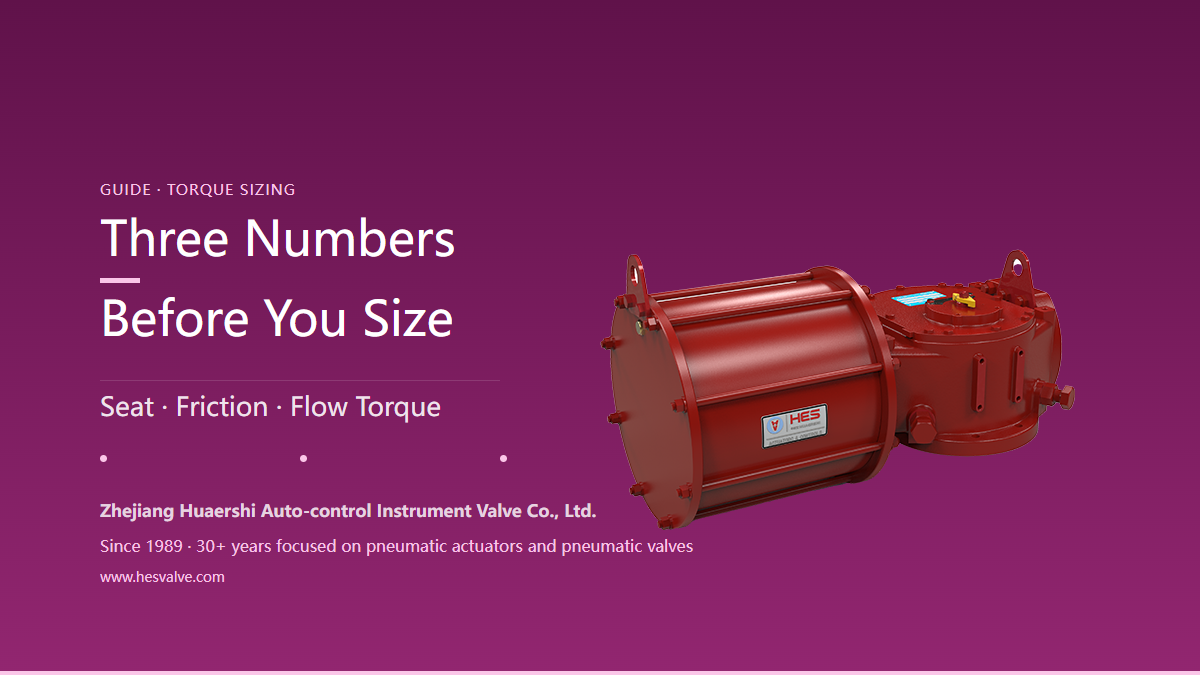
Torque is the first thing to calculate in actuator selection. Too little and the valve will not seat, with the seat scoured in service; too much and you pay for capacity you cannot use while the stem and seat take impact damage. Both directions are wrong.
Behind the word "torque" sit three numbers - breakaway torque, seating torque and flow torque - plus one safety factor. This article covers all four the way they are used on site, then how to verify.
1. Torque Has Three Components
1. Seating torque (the baseline) Friction from pressing the disc or ball onto the seat. It depends on seat load, seat width and friction coefficient - which is why torque varies so much between valve types and seat materials.
2. Bearing and packing friction Stem bearings and packing. Often overlooked, but a significant share on high differential pressure, large bore and seldom-operated valves; over-tightened packing can raise torque noticeably.
3. Flow torque (from the moving media) Dynamic torque as media passes the disc or ball, most pronounced on pump start/stop, fast cycling and large bore. Catalogues rarely show it, yet "it opens fine until the pump starts" is usually this term.
The judgement rule: catalogue torque is a static, clean water, ambient figure. Your duty is dynamic, possibly with solids, possibly hot - the two are not the same number.
2. Safety Factor: By Duty, Not by Instinct
Common ranges (engineering practice; follow project specification):
-
Clean media, ambient, normal differential pressure: 1.2-1.3
-
Solids, scaling, viscous media: around 1.5
-
High temperature, steam, frequent cycling: 1.5-2.0
-
Hazardous areas, emergency shut-off: 1.8-2.0, calculated at the worst differential pressure
Two cautions:
-
A larger factor is not automatically safer - a bigger actuator raises impact load on stem and seat, which can shorten life
-
The factor belongs in the sizing calculation, not in a feeling that "it should be enough"
3. Breakaway and Seating Torque Differ
-
Ball valves: seating torque is usually higher than breakaway torque (the ball must be pressed onto the seat); especially true for floating designs
-
Butterfly valves: peak torque often occurs around 60-70° of opening, not at either end, where flow torque is strongest
-
Gate valves: sized on thrust (N), not torque, from "differential pressure × gate area + friction"
-
Conclusion: ask for a torque curve, not a single value - a single value guarantees one point, a curve covers the whole stroke
4. Temperature and Differential Pressure Combine
-
High temperature: seals expand and material strength falls, so seating torque rises; metal seats especially
-
Low temperature: seal materials harden, torque also rises, and low-temperature brittleness must be considered
-
Direction of differential pressure: reverse differential pressure can change torque noticeably; bidirectional seats must be checked from both sides
-
In practice: put maximum temperature, maximum differential pressure and media state into the calculation together, not each at its average
5. How to Verify: Measure Dry, Then Loaded
-
Dry torque: actuator without the valve, measuring output against the rating
-
Loaded torque: with the valve connected, at real differential pressure, proving it can actually seat
-
Ask for curves: a torque-versus-stroke curve plus per-unit factory records, not one generic catalogue sheet
-
Three signs of inflated ratings: figures well above international brands of the same size, refusal to provide measured records, and quoting only bore without torque
6. Structural Match and Margin Strategy
-
Rack-and-pinion: smooth output, suited to small and medium bore with normal cycling
-
Scotch yoke: higher torque at 0° and 90°, exactly where butterfly and ball valves resist most - the choice for large bore and high differential pressure
-
Do not oversize: one size up also raises stem and seat load and can shorten life
-
Package capability: actuator and body developed together, so interfaces and torque match by design; torque 8-6000 N·m for DN15-DN800 across more than 100 models
-
Delivery: standard models in 7-15 days at about 40% of imported cost; full in-house manufacturing, eight authoritative certifications, reject rate below 2%
-
Applications: municipal wastewater (valve and actuator packages, maintenance cost down about 30%), chemical RTO (explosion-proof ball valves and actuators), sheet metal and metallurgy (high-torque scotch yoke replacing imports, lead time halved), exports to more than ten countries
Conclusion
Four numbers decide torque selection - seating torque, friction torque, flow torque and safety factor. Miss one and the selection is only "about right". Put all four in the calculation, then ask for a torque curve and measured records; that is worth more than ten catalogue sheets.
If you have a specific bore and differential pressure, send them over for a free torque calculation and selection recommendation.
Zhejiang Huaershi Auto-control Instrument Valve Co., Ltd.
Since 1989 · 30+ years focused on pneumatic actuators and pneumatic valves
Website: