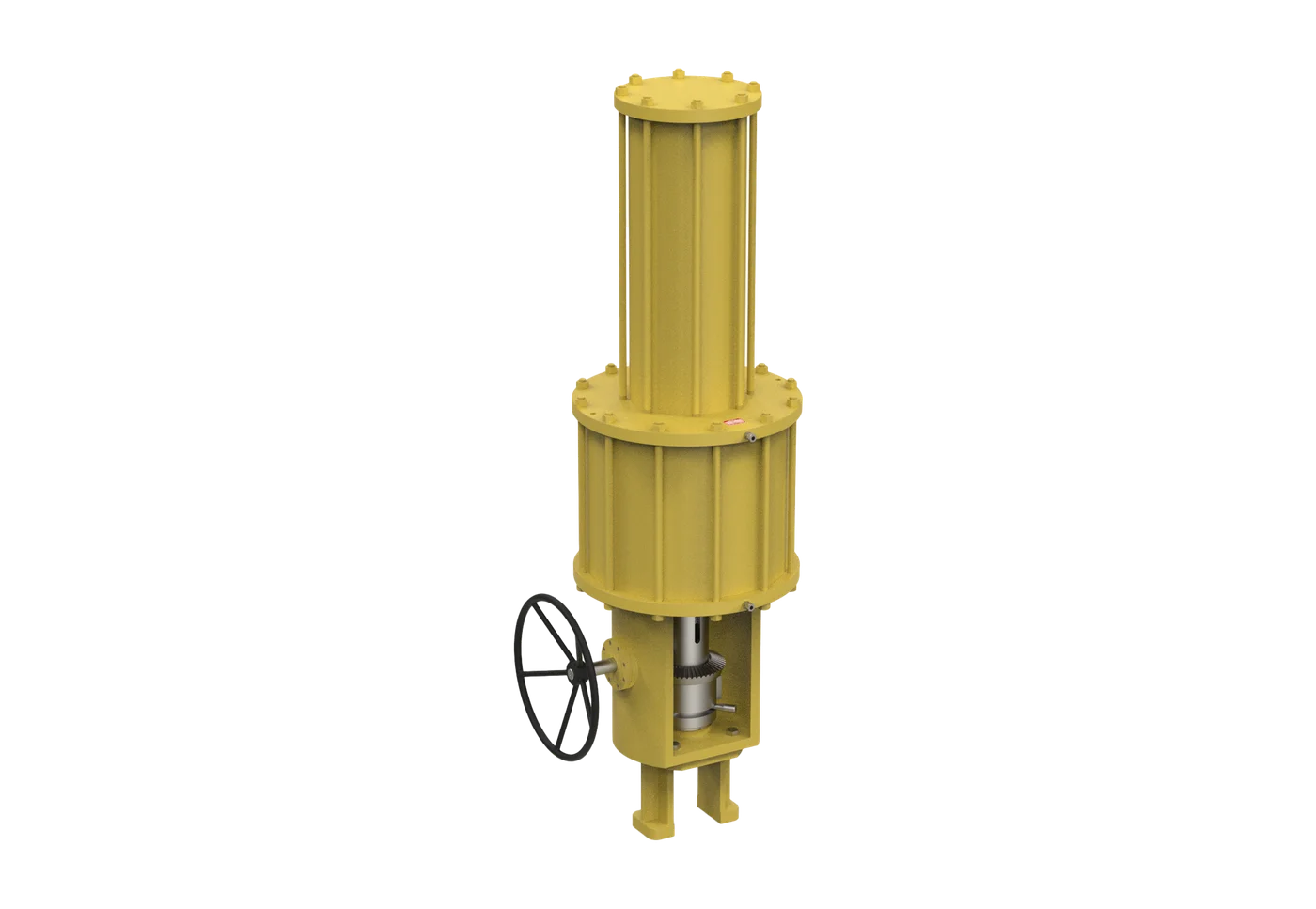
Alongside the familiar quarter-turn actuators that rotate through 90°, the pneumatic actuator family includes a type designed specifically for reciprocating linear movement: the linear pneumatic actuator. Powered by compressed air, it opens and closes gate valves, globe valves and other linear-motion valves. It is also an ideal industrial automation device for centralized or individual remote pipeline control. This article explains its construction, operation, installation and maintenance to help you fit and use it correctly.
1. A linear drive for gate and globe valves
Linear pneumatic actuators are mainly used for valves requiring linear movement:
- Gate valves, globe valves and other linear-motion valves.
- Extension and retraction of the piston rod raise and lower the valve stem to open and close the valve.
- Suitable for automated industrial piping requiring centralized or individual remote control.
2. Operating principle: how air raises and lowers the stem
The core is the linear movement of the piston and piston rod. The principle is straightforward:
- Air enters the lower cylinder port → pushes the piston → the piston rod moves upward → the connected valve stem rises → the valve opens.
- Air enters the upper cylinder port → pushes in the reverse direction → the stem moves downward → the valve closes.
Cylinders are available in single-cylinder and dual-cylinder arrangements, selected according to thrust and stroke requirements.
3. Installation: the stem and piston must be coaxial
The most important rule is that the valve stem and piston must be installed coaxially.
- Poor alignment causes side loading of the piston rod and uneven seal wear, accelerating damage and potentially causing seizure.
- Allow the piston rod and valve stem to align naturally, then tighten progressively. Do not force them together or hammer them into position.
4. Post-installation testing: free movement without binding
Installation is not complete until an assembled functional test has been performed:
- Test the valve and pneumatic unit together.
- The stem must move up and down freely, without sticking.
- The valve must reach fully open and fully closed positions with the correct stroke.
Do not put the assembly into service if it fails the test.
5. Routine maintenance: drain the filter regulator regularly
For long-term stable operation, the key maintenance rule is simple: take care of the air supply.
- Regularly remove water and contaminants from the pneumatic unit's air filter regulator.
- Keep the air dry and clean to stop moisture and contaminants entering the cylinder and affecting piston movement.
- If movement becomes slow or sticky, check the air supply and filter first.
Conclusion
Linear pneumatic actuators are simple and reliable when aligned correctly, tested for free movement and supplied with clean air. Remember three essentials: coaxial installation, assembled functional testing and filter drainage. Contact our professional service team for support with linear actuator selection and installation.
Zhejiang HES Automatic Instrument & Valve Co., Ltd. Established in 1989 · More than three decades dedicated to pneumatic actuators and pneumatically operated valves